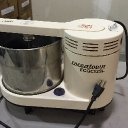
For Sale used 2 x Premier Wonder, 1 x ACMC tempering and 10 x polycarbonate molds
Posted in: Classifieds ARCHIVE
Email sent.
updated by @José Crespo: 06/23/16 20:56:01

Email sent.
I am changing direction so I am seeling all my home-based hobby chocolate equipment. I have a:
2 x Premier Wonder. Great little machines that were used only few times each and bought new a year ago. $130 each.
1 x ACMC. Used ACMC chocolate tempering machine. Works great and includes 2 bowls and 2 baffles for multiple matches. Does not include lid/dust cover. I have bought it used so I don't know how many times it was used before me. I have used 3 times and works great. $420
10 x Polycarbonate chocolate molds. Barely used polycarbonate chocolate molds for bars that I bought new. The models is CW2110. No scratches in the surfaces. Dimensions are 6.1x3.0x0.3 in or 156x77x8 mm, 3 cavities, approx 2.85oz or 80 grams. $130 (13 each).
Contact me at davemuci gmail
Hello @honmeid,
Welcome to Seattle (when you arrive, that is)! I don't know of any jobs, but here's a list of bean-to-bar companies in the Seattle area:
Of course, you have likely already heard of chocolatiers like Fran's. I'm not as familiar with the confectionaries, but you might want to look at Fran's, Oh Chocolate!, Hotcakes, and Intrigue Chocolate. Aaron Barthel at Intrigue is very highly regarded.
http://www.seattlemag.com/article/best-chocolate-shops
http://www.yelp.com/search?cflt=chocolate&find_loc=Seattle%2C+WA
http://www.getyourhotcakes.com/
Good luck!
Blessings,
Andrew
Yes. Use a fogger, tent/tarp your pallets to maximize contact / exposure time, and place your fogger under said tent. anything that ends in 'cide (pesticide, insectide, etc) i don't think i'd characterize as harmless to humans, so don't go looking for opportunties to breath it in or take a bath in it. It's very commonly used as part of routine pest management cycles, and will be most effective if you're storing in bulk to use on a regular basis (ie don't wait until you've got a room full of moths to begin treating).
Sebastian - Do you have any experience or opinions using permethrin spray to control and combat cocoa moths? It's available commercially in quantity, not too expensive, and appears to be harmless to humans and lethal to moths and larvae of not only cocoa moths but other insect pests.
Disclaimers
I purchased my copy of the English–language version of Chocolate – The Reference Standard at full face value at the Origin Chocolate event in Amsterdam in October 2015. It was not given to me as a review copy. In reading, I noticed a favorable mention of TheChocolateLife (p875). This did not influence my re view. On a side note, it was the marketing department of my publisher, Gotham Books, who decided to include the phrase “… The Ultimate Guide …” as the tag line on the cover of my book, Discover Chocolate, over my objections. Sadly, to me, “ultimate” was prophetic in one respect – it is still the only book of its kind.
Chocolate - The Reference Standard
Germany [Bonn]
http://www.thechocolatetester.com/home/
Overall Rating: Six pods (out of six) for sheer scale. One pod (out of six) for objectivity and reliability of information.
Processing stage : Unedited or lightly edited translation (Unconfirmed).
Price category: €€€€€
As Rick and Mike Mast have been so publicly reminded over the past few weeks, if you are going to make superlative claims for your product, you had better deliver on those claims. This is a lesson that Georg Bernardini, author of Chocolate – The Reference Standard (“TRS”), may well be forced to learn.
By deliberately renaming this edition of his book The Reference Standard (p14) , the task the author set himself was not just to create a broad survey of available chocolate (4,400 individual products from 550 brands from 70 countries, according to the author: I did not count them) but also to ensure that the information presented as fact is, in fact, factually accurate. In other words, to create a volume that actually deserves to be held up as not just a reference standard, but as the reference standard.
With respect to the former task of creating a survey of currently available chocolate, Bernardini set himself an almost impossible task because no matter how comprehensive the attempt is or was, there were and are bound to be many companies overlooked or given short shrift, and much of the information, especially about the products and companies would be out of date by the time the book went to press.
Nonetheless, it is the scope and expansiveness where TRS is the most satisfying. Although I have been involved in chocolate professionally since 1998 and have been writing about and reviewing and rating chocolate since 2001, there are companies in this book I had never heard of before. Not “known about but never tried,” but genuinely never heard of before. The little trill of discovery when running across a new name is cool—it some rate an entry in my travel journal as a place to visit when I can.
The information about the companies is presented in a reasonably consistent and generally approachable and understandable fashion. It’s possible to skim the book looking for a known favorite brand (entries are arranged alphabetically and there is a listing up front) or to scan the book for companies that are rated highly (five or six pods) or that Bernardini is less sanguine about (none or one pods).
It’s this grazing aspect of consuming the book that makes it fun but the fact that there is a whole lot to consume lends an un warranted perception of value to the book; it is when you stop grazing and actually start examining TRS closely that some very real flaws reveal themselves.
Flaws, that, in my opinion, make the book dangerous and its author not someone to trust, let alone laud.
To be fair, it’s hard for me to know from where many of the flaws stem, because I am not fluent in German. But when you start reading the book it’s quickly clear that after the book was translated there was none, or only very little, editing or fact checking done by anyone whose first language is English or who is knowledgeable about cocoa and chocolate.
TRS is littered with grammatical and typographical errors, and the awkwardly convoluted structure of many sentences clearly comes from TRS’s German–language origin. The first times I came across these, they struck me as amusing. Very quickly, however, the quirky sentences became annoying because they make trying to understand what the author actually wants to convey much more difficult and many times impossible.
More troubling, to my mind, is that there are some things that are presented as fact that are ambiguous or just plain wrong. And it’s here that my lack of understanding of German (and my unwillingness to fork over another €50 plus shipping for a German-language version of TRS) comes into play.
I just don’t know how many of the errors are in the German-language original or if they crept in during the translation. The translation may be the source of some specific jarring language choices that are not in the original. Two examples, gladly forego on the cover and the overuse (to my mind) of the words tolerate and suspect . (TRS is offered up as a reference standard, so nothing should be suspect. It should be verified and fact-checked as true, or it doesn’t warrant inclusion.)
I suspect (this is a review and I am not claiming it to be a definitive reference and I am going to use the word to highlight several points) that the source of some of the factual errors in TRS are a result of the translation, but I don’t know that this is the case in any specific instance.
For example, in the section on cocoa sourcing and the Dominican Republic (p34), the text reads, “The two most frequently cultivated varieties are Sanchez and the prestigious cocoa bean Hispaniola.” Actually , Sanchez and Hispaniola are not varieties of cacao, they are terms that refer to fermented beans (Hispaniola, from the name of the island), or the lack of fermentation (Sanchez, from the name of a port). The question is, is the source of the error the translation (I think not in this case), or is it actually a fundamental misunderstanding on the author’s part? If the latter, then that calls into question everything the author claims as fact: What does he really know? What can we trust? What can we take at face value as being true?
I don’t know.
And in this specific instance I am consciously committing the same act that lies at the heart of my main criticism of TRS and the one that undermines its credibility and any claims it has to authority: I am being lazy . I could easily reach out and find someone who owns the German-language original and ask. But I did not, in order to make the very particular important point that there are many places in TRS where Bernardini has been lazy, and dangerously so because of claiming the mantle of reference standard.
An egregious example of this laziness is in the entry for Perú’s Cacaosuyo (pp 239-40). Bernardini opines that the processing stage Cacaosuyo occupies is “Bean-to-Bar (Unconfirmed)”.
The text reads, “It is not quite sure whether the company actually manufactures the chocolate itself. Too often it is rumored that they are private label products … It is hard to believe that the company controls all steps from cultivation to manufacture … For this, the communication and transparency are too meager for me [emphasis added].” And in the Summary, “A little more communication and transparency on their website because, apart from a logo, there is nothing and it would do the credibility of the company good.”
The only way I can read this is that Bernardini relied on reports of rumors and a lack of information on their website to punish the company by questioning its integrity with the Unconfirmed label. Apparently, Georg did not actually take the time or make the effort necessary to find out for sure one way or another: he perpetuates rumors with innuendo. To what purpose? What does this say about Bernardini’s integrity?
Note : I have personally visited the Cacaosuyo factory in Lima and have seen the process from the bean to finished bars. I have not visited the farms, but have spoken extensively with Samir Giha about them.
The entry for Pacari is similarly lazy and dismissive, but here’s where the deep waters of editorial decision-making become murky when a competitive entry is examined closely.
Quite rightly, Bernardini recuses himself from writing the review for Ecuadorian chocolate company and Pacari competitor, Hoja Verde (four pods, pp440-43), because he points out that he consulted to them in 2013.
Notwithstanding this distancing, Hoja Verde, which does not make its own chocolate, is given four pages of editorial where Pacari, a much more highly-respected and better-known brand internationally, a brand that consistently places highly in international competitions where Hoja Verde does not, rates the same four pods but just two pages (pp641-42) and is given the reputation–questioning (Unconfirmed) status label.
Even Valrhona , arguably one of the five most important companies in the book, rates only two pages plus a paragraph (pp792-95). Bonnat gets two pages (pp220-22) and six pods; Cluizel, a shade over two pages (pp289-291) and the same four-pod rating as Hoja Verde; Domori two-and-a-half pages (pp339-241) and six pods. Utterly bafflingly, Felchlin rates zero pages though is mentioned in passing as one of the best, if not the best, private-label manufacturers in the world!
Given these direct observations of what did and not make the cut, I can’t help but wonder how much Bernardini’s involvement with Hoja Verde did actually factor into the hard–to–believe editorial decision to give them far more love than many far more important and deserving companies. As the publisher, responsibility lies solely in Bernardini’s hands.
Favoring Hoja Verde with so much unquestioning editorial makes no sense in a book that purports to be The Reference Standard with a focus on “the best … in the world.”
Note : I have not personally visited Pacari’s operations in Ecuador. However, I have contacted people who have visited Pacari over the course of years, who know what to look for, and whose integrity is above reproach.
There are other examples of this laziness, or suspected undisclosed bias, throughout the book. Patrice Chapon (for example) is also punished with the (Unconfirmed) label, and reading the lazy and superficial explanation leaves me wondering if there is something personal behind the review.
For me, this consistent pattern (barely–known companies being given a lot of coverage and well–known companies being overlooked entirely or having comparatively few products reviewed and rated) who are clearly not “the best in the world … [that] we would gladly forego” is a key factor that undermines both the credibility and authority of the book as there are no clear guidelines about what was included—other, I suspect, than what Bernardini could get his hands on to review.
And It makes me wonder if there are any other instances where editorial coverage was influenced for personal or business reasons. Was, for example, the Maison Boissier review influenced in any way by the full page ad for The Salon du Chocolat?
Why I Say TRS is a Dangerous Book
TRS is self–published, and hiring experienced and knowledgeable editors and fact checkers to review a book of this breadth would be a very expensive proposition. However, for a book that calls itself The Reference Standard , it is precisely at this point where the author/publisher has undermined his own efforts, let down his readers, and created a situation ripe for dangerous exploitation.
As was revealed during the unfolding Mast Brothers story, the people reporting the story took the claims the Brothers made at face value and, at least apparently, did no fact checking. This meant that no one methodically looked at and publicly challenged their claims to have (for example) created/invented/innovated the entire production pathway they used until the series of articles on DallasFood.org. The Brothers (deliberately and cynically in my mind) took advantage of the lack of knowledge of media covering them and the consuming public, and coupled with some strategic endorsements from chefs who probably should have known better, were able to advance their claim that they made the best chocolate in the world.
It is exactly this confluence—ignorance (of chocolate), gullibility (it’s such a huge book it must be valuable/good), and lack of critical questioning—that lulled media and organizations and individual that should have known better into endorsing (explicitly or by implcation) both The Reference Standard and Georg Bernardini.
This uncritical institutional acceptance only serves to give weight to the claim that the book is, in fact, deserving of its self-attribution as The Reference Standard . There are ideas and errors of omission and commission in TRS that will be perpetuated for years, and reputations called into question because Bernardini was either lazy or cheap in not editing the translation or fact checking very important facts, and possibly favoring at least one company over all others.
Despite these flaws and many others, people are citing the book as a credible and authoritative source. The fact that TRS is a print publication does a great deal to imply the credibility that to my mind it does not deserve; the book was out of date before it went to press; any errors due to mistranslation or other reason cannot be corrected or discussed. If the information were online it would be far more usable (assuming the database was searchable), though far less valuable – to Bernardini’s reputation. A point that I believe is not lost on the author (who is also the publisher).
Summary
In the end, readers of Chocolate – The Reference Standard should recognize that the ratings and reviews represent the opinions of a single person (with the exception of the troubling Hoja Verde entry). They are not gospel, the truth. They represent the opinion of one person. Your experiences tasting these chocolates will differ.
In part this is because not all products mentioned in this edition were rated specifically for this edition and may not represent the current state of the product, which may have been reformulated since being reviewed in a prior edition. Furthermore, among craft bean–to–bar chocolate makers especially, great pride is taken in the fact that their chocolate is not meant to be the same from batch to batch. Nowhere in any of the reviews of bean–to–bar chocolate I read did I notice any indication of which batch was tasted, even when that information would have been available. Thus, it is virtually guaranteed that whatever you taste it will not be what Bernardini tasted, reviewed, and rated.
And where is the reference standard value in that?
While we can marvel at the effort required to compile such a collection of entries in a very short period of time, it is also that effort in such a short time frame that undermines their reliability. We should not blind ourselves into believing that the quantity of effort involved is in any way equivalent to any qualitative aspect of that effort. I have pointed out just a few of those aspects above. There are many, many , more.
At best, TRS is a survey of a sampling of products from over 500 brands that Bernardini could get his hands on, and not, as the cover proclaims “The best chocolates and pralines in the world; What’s behind it [sic] all and what we would gladly forego”. If these are the best chocolates and pralines in the world – why would we gladly forego any of them? So, it’s important to recognize that TRS is a personal, idiosyncratic survey and sampling, one that because of its vastness is rife with errors of omission and commission, filled with factual errors, and that would be far more usable and useful if it were not distributed on dead trees.
Conclusion
I would like, in any comments, for members to focus on fact checking the book, not engaging in nit–picking the ratings and reviews of specific products, which, as I mention above, are completely personal. But – if there are factual errors in the book, I think everyone who owns a copy or refers to TRS as a reference standard should know about them. I can’t know everything and I don’t have the time to go through the book with a fine–toothed comb looking for them.
Listing image by @vera-hofman as posted on TheChocolateLife.
yomogi..
tansy?
"Yomogi" is a kind of fragrant herb.
I never ate yomogi of chocolate.
Thanks for the good information.
They're cocoa moths. Preetty soon they'll be flying everywhere. They're on all cocoa beans, from every origin.
Keep your beans in a cool and dry place and the eggs won't hatch. If you need to fumigate, that's also done regularly in cocoa warehouses all around the world.
It is impossible to order beans from anywhere in the world that will not have an infestation issue over time, if improperly stored. Anyone who tells you otherwise is lying or inexperienced.
Hi everyone,
not sure how common this is as i cant find much information about it. Basically i got a small sample of cocoa beans from venezuela, didn't get around to trying them out for several months, but i just came to trial them out and found a weird bug/lavae type thing on the inside of the sack, at first i thought it might be just a random bug as i have never come across it before, however i roasted a batch 130 centigrade for about 15mins. But cracked open a bean to test the nib flavour and found another lavae inside it. I did a bit of research and found that it could be the 'warehouse moth'. But no information on how to go about getting rid of it.
Has anyone else had a similar issue, or heard of these pests? and what can be done to either get rid of them? or what process do you undertake to sort out beans with potential bugs against safe beans?
major help needed as concerned about ordering any large amount, from what is otherwise a very nice flavoured bean.
thanks
James
We are a small batch chocolate maker in Austria, working bean to bar for our ZART Chocolate Makers product range.
For our pralines and other bars (not! indicated as bean to bar) we use couverture. (although we use of course some of our "homemade" chocolate in truffles). We intend to grow our chocolate making capacity, to cover our entire need in the pralines from our own but that is a longer process.
By "hand blender" i meant a stick blender. Thank you for the response that i dont have to invest that much money  . Maybe i will invest a little bit in a better stick blender (more rpm) since mine is really old and not made for 2 kg batches. I also will try to optimize my recipe for ganache. Just for information: I ONLY make ganache to cut and coat it later in our enrobing line. So i try to make the recipe as smooth and fine as possible which is still "cut-able". I also make a bottom and a top chocolate (foot?) and cut it with the guitarcutter while the top (foot?) still soft to get perfect edges. This works great for me. Still i will experiment more for finding a better recipe.
So i guess the Vacuum unit at some mixers is only good for better shelf life and doesnt affect the texture of the ganache.
(sry for my "not so well" english  )
)
Maybe
It is this information,too.
List of bean-to-bar chocolate manufacturers:https://en.wikipedia.org/wiki/List_of_bean-to-bar_chocolate_manufacturers#cite_ref-LondonAcademy_2-0
Everything you need to know about making bean to bar chocolate at home can be found here: www.chocolatealchemy.com. I'm not affiliated with the site, I just use it.
I think so.
When I learned the price of "bean to bar chocolate", I surprised.
However, it is natural to high compared to goods on the market.
Because, I think there is a need to understand the difference.
Wagashi is japanese confectionery.So is it.
Nobody complain.
I think it's because everyone knows the reason.
I want to carefully convey the words and goods.
Thank you both.
I live in Japan.
I am an amateur.(*'-'*)
That has become a great help.
If you need high quality seeds :
https://cacao.farm/product/cacao-seeds-theobroma-cacao-amelonado/
We accept only bitcoin at our web store. (Just as cacao beans at some point were used as currency)
If interested you can use Circle or Coinbase to purchase.
Good luck!
I'm interested. Did you buy the unit new? How many hours on it?
Where are you at? Both Rutgers and Penn State have cocoa trees growing at their campuses...
Hi Annette.
I'm interested in your activities .
It might be difficult.
But, I believe that if I can also grow cacao tree in Japan.
And if successful it is wonderful.
I'll study harder in future.
こんにちは。Hello.
This is a list of Japan. Still very less.
Thank you for the good information.
I was surprised that you use the hair dryer.
I feel I can do it.
thanks
I agree with Sebastian. A good stick blender (I paid $50 for mine) can give you a wonderfully smooth ganache (and I've eaten more than my fair share of Parisian chocolates)
All you really need is a good stick mixer (burr blender), and a recipe you're happy with. You can make a fantastically wonderful ganache without spending 10's of thousands in capital. If you're not satisfied with the ganaches you're currently making, i don't think an expensive piece of equipment will change that. Not knowing your details, i'd focus on the recipe. if by hand blender you mean a beater blender (two rotating beater blades), i'd suggest you consider an inexpensive stick blender (it's a very high RPM/shear mixer where the blades meet the ingredients; downside is that it's a small unit, so it takes longer to get full contact with all the ingredients)
Thank you for the information. Sounds logic to use either a stephan mixer OR a Cadix but not together.
ok, the reason why I am so interested in such things is because i tried some great ganaches from top chocolatiers from paris, like henri le roux or patrick roger, and (apart from there delicious taste) they got a very smooth and still cutable ganache. Especially I like the texture of the ganache. I made alot of ganaches by myself and never got that smooth and fine texture (tried alot of different ratios, added glucose,invert,sorbit,hony,...), so I was thinking it has something to do with my equipment (hand blender) and so i started looking what they use (and found the machine which you see in the pictures).
After seeing that alot chocolatiers use a stephan mixer with vacuum I am thinking my process adds some air into the ganache which affect the texture. unfortunatly these machines are very expensive.
Does someone made similar experience?
edit: or maybe to summarize: Does a Vacuum mixer (like Stephan) makes a different texture than a handmade (or hand blender-made) ganache?
Email contactus@eatingevolved.com for more information.
For sale, used Cocoatown melangers in good working condition with new belts. Multiple units available for purchase.
Unit description:
ECGC-12SL CocoaT Melanger is a granite stone on granite stone grinder to grind cocoa bean nibs to chocolate liquor. Melanger is an ideal tool for chocolatiers who want to make chocolate from bean to bar or cocoa nibs to cocoa liquor. The melanger has enhanced ventilation system and helps to grind 8 – 10 lbs of cocoa nibs for 24 hours or more.
Melangers have two #3 black granite stone rollers that rotate at 135 -140 rpm on a granite slab. This creates tremendous shear and reduces the particles of sugar and cocoa to the smoothness expected in modern chocolate, about 15 micron range.
The roller stones and wiper are attached to the stainless steel shaft, and the whole roller stone assembly, is removable as one piece. They are easy to clean, handle and store. The roller stone assembly is locked into the lid for reproducible tension. The conical roller stones serve dual function – conching in addition to grinding.
Deluxe Melanger is ideal for small chocolate businesses or for R&D to develop recipes for big businesses. In addition to grinding cocoa nibs, deluxe melanger can also be used to grind nut butters, tahini, and more. It grinds upto 8 lbs of cocoa nibs in a single batch.
$250 per machine.
Does anyone have any recommendations for good places for hot chocolate in and around New Orleans USA?
Thanks!
Giselle
www.ultimatehotchocolate.com
Hi
I spent a few weeks in Oaxaca tasting and making hot chocolates. I wrote up several articles about my experiences on my blog Ultimate Hot chocolate (www.ultimatehotchocolate.com).
I found without my difficulty local women who taught me a variety of ways to make different locally loved hot chocolates. Everyone here drinks hot chocolate and it is an important part of big cultural events such as weddings etc. So groups often come together to make family recipes the traditional way.
Hi!
My name is Giselle and I have been reading chocolate life posts for a few years now on and off.
I write a blog called Ultimate Hot Chocolate which is about my travels around the world in search of the ultimate hot chocolate. The blog is part travel blog with tips about the locations I visit and part cafe/restaurant/chocolatier review blog with notes on the hot chocolates I find. This year the blog will also have recipes added. You can find it at www.ultimatehotchocolate.com
I am always looking for great spots to visit on my travels so if you have a favourite hot chocolate please let me know and if I am ever in your area I will definetly check it out.
Larry, thanks for the informative thread on the DIY cooling tunnel. Its cool to see other MacGyvers out there...I like the DIY approach whenever possible. It kind of suits my mindset on many things.
A proper cooling tunnel would theoretically work in my space, but it would take up so much space to rend it an impractical solution for me.
I guess I'll stick to parchment paper for the belt...I was just curious, since I saw a video of the belt with a silpat type material, and thought it would be cool to do. I do this with textured acetate sheets when I hand-enrobe...guess I'll stick to that when wanting the textured foot.
I'm just hoping to make good use of the JKV with all its attachments, now that I have it operational in the space. Turns out the space was already wired for 3-phase, (if you recall my previous thread on the subject), so I didnt need that phase converter after all. Was a shocker to both me and the owner of the building, when the electrician told us we were good to go!
Dallas,
I suspect the 2m take-off belt is too short. I've read that chocolates about 8 minutes in a cooling tunnel to set properly. Thus with an 8 foot cooling tunnel, the belt can move 1 foot per minute. a 16 foot cooling tunnel allows the belt to move at 2 feet per minute and so forth.
The challenge with just having the take-off belt (no cooling tunnel) is the chocolates would have to sit for quite awhile before being able to touch them to take them off the belt. Like Clay mentioned, the paper take-off allows you to move the chocolates elsewhere to cool and set.
Do you have space for a cooling tunnel? the old chocolate life website has basic instructions on building one, or you could add a manufactured one to your system.
There is no particular reason to heat up cream in the Cadix and transfer it to a Stephan unless the Stephan has a vacuum attachment and the Cadix does not. If that's the case, then it may simply be a volume issue - the Cadix is a large heated vessel. You can get Cadix Pros with vacuum attachments.
As Sebastian points out, heating the cream to a certain point can help with shelf life and a high shear mixer is good for creating stable emulsions.
If your volume requirements are much smaller and you don't need the vacuum, something like a HotMix Gastro Pro might be worth looking at.
Interesting, re: textured-belts. I have a 2m long take-off belt, so its something I could definitely consider. I like the textured foot look.
I have 3 Martellato M2000 Bar Molds for sale. They are in great shape, I used them for about a month and decided to use a different mold. The plastic is very thick and sturdy
New - http://www.bigtray.com/martellato-usa-inc-chocolate-mold-ma2000-sku-mloma2000-c-14630.html
Pictures
Asking $50 for all three molds, plus $5 for shipping or local pickup in Portland OR. Thanks for looking
@dallas - commonly used on enrober (take-off) belts, no; they are most often found on cooling tunnel belts.
The take-off belt on most enrobers is too short for the chocolate to completely set, that's why paper or parchment is used to cover the belt and to make it easy to transfer the product to some other location to finish cooling. The textured belts (often with a logo) are custom-order items.
I've never used a cadix, but these types of things are useful as they're high shear, heated mixers. Some of them can pull a vacuum. Very good at mixing things up and cooking them simultaneously. In a ganache, heating the cream can help form a better emulsion, and if you get it hot enough, can help with shelf life.
I came across a short video on the internet showing an enrober belt with what appeared to be a silpat-styled belt, or cover. I've got parchment paper rolls or acetate rolls, but a re-usable silpat would be pretty cool. You get the texture of the silpat on your bonbon bottoms too...I like that look.
Is this something commonly used on enrober belts?