Resulting chocolate flavor quality from ball mills
Posted in: Opinion
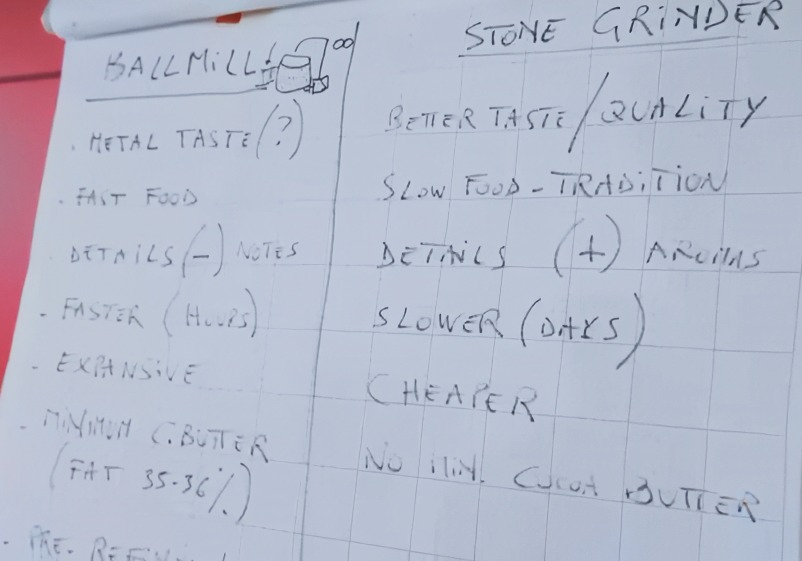
Thanks so much for your take on this, Sebastian. I realize there are specifics involved and it's hard to generalize broadly when there are so many variables involved in machine operation and engineering, but I imagine the presentation's chart was made targeting either general characteristics or those specific to the company's offering. The latter I find hard to believe, especially since their ball mill has "separate heating and cooling circuits." I presume they have decent temperature control and thus their ball mills, as you say, should be quite wonderful.
Thanks for the chart. That's interesting that it appears the ball mills yielded less fat. I would have liked to see what the resulting particle size distribution curves looked like. That's about the only way I can think the resulting fat content could differ. Although, with n=30, would the outcome have been different with n=300? There was a lot of variation in the results! And even if not, I can't imagine being able to discern a difference between the averages of 54.96% and 55.43% fat. The conclusions I'd draw from this study is that differences in resulting fat and moisture are irrelevant.
You mentioned there were measurable differences in other compounds, though. A question just for fun: If we just assume that a melanger produces better flavor and attribute it to the slower volatilization of flavor compounds (not saying this is the case!), do you think careful temp and air control during a subsequent conching program could yield roughly the same results?
The size of the target is always important in real life: People would notice if I went sky diving and landed in the wrong field, but no one would see if I failed to depress a blade of grass I was aiming for. This is theoretical and purely because I'm interested.