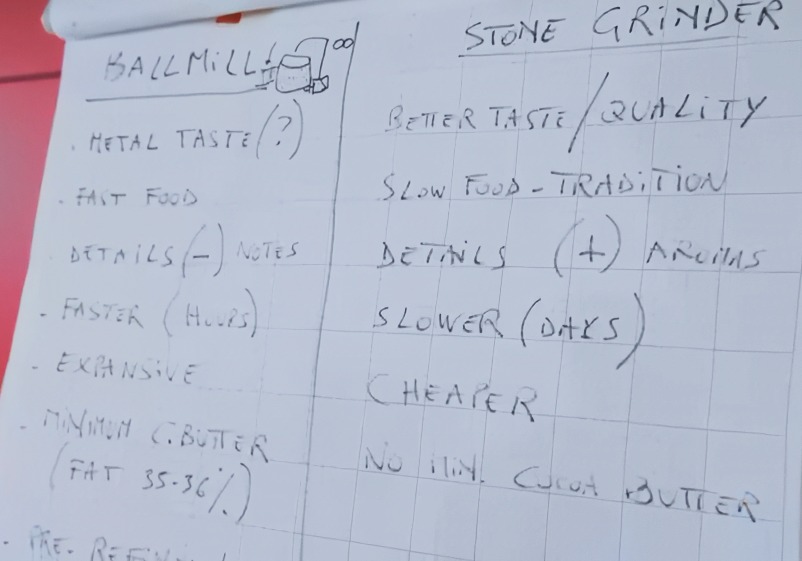
Skwerl: I am guessing that this marketing video was not published by a ball mill manufacturer <grin>.
Taste/Quality. If there is a metal taste from chocolate made in a ball mill the operator is likely not maintaining the mill properly, Used and maintained properly there should be no taste of metal in the chocolate. I often recommend that users of melangers lick the stones so they can identify if they are refining stone dust into their chocolate. (This is easy to do if too much pressure is applied. If there is, for example, a visible groove on the base the stone has to be somewhere – and that somewhere is in the chocolate. And stone dust can’t be removed, while small bits of metal can – with a magnetic trap.
Ball mills are not conches, so a separate conching step is required. I would never expect what comes out of a ball mill to be finished from a flavor perspective.
And quality is a different issue entirely.
Fast Food/Slow Food. Melangers are the original “fast food” machine for chocolate manufacturing. Before the melanger was the metate, So while I understand the point, I don’t agree with it 100% – it’s not one I would ever use.
Details/Notes. This is down to proper usage. I’ve tasted a lot of both under- and over-processed chocolate out of a melanger. Any technology can produce “good” as well as “bad” chocolate. This is too broad a statement to take seriously.
Faster/Slower. This is a restatement of the Fast Food/Slow Food argument. Slower is not always better – but, because time is money, slower may be more expensive.
Expensive/Cheaper. This is not a true dichotomy at a fundamental level, and it may not be true, I can purchase a 100L ball mill for ~€25,000 and a restored vintage 50L Lehmann melanger for $35,000. There needs to be a lot more specificity. You also need to consider throughput in the cost structure, not just CapEx. A 100L ball mill might produce 300L of finished chocolate/day. It could take 12-18 days for the 50L Lehmann melanger to produce the same amount.
Fat content. This is generally true, the minimum cocoa butter content in a ball mill is likely higher than the minimum in a melanger. But there is an implied value judgment here that less cocoa butter is always better – which is demonstrably not the case.
Pre-refining. It is less efficient to refine anything through > 1 order of magnitude in a single pass no matter what technology is used. Melangers are more efficient (faster) if paste is added, not nibs. But they suck as conches because that is not what they were designed for. Most makers use melangers because:
- You can get small ones for little money
- They are straightforward to understand
- Recipes tend to scale from small melangers to bigger ones
- Only one machine is required (less materials handling)
But those points do not automagically mean they are a better choice for every situation. When the Mast Bros had a line of 20 Cocoatown ECGC 65s in a rown in their Williamsburg shop they picked the least environmentally responsible way to scale production I can imagine – energy usage, heat produced, etc, etc
--
~~~~~~~~~~~~~~~~~~~~~~~~~~~~~~~~~~~~~~~~~~~~~~
@DiscoverChoc