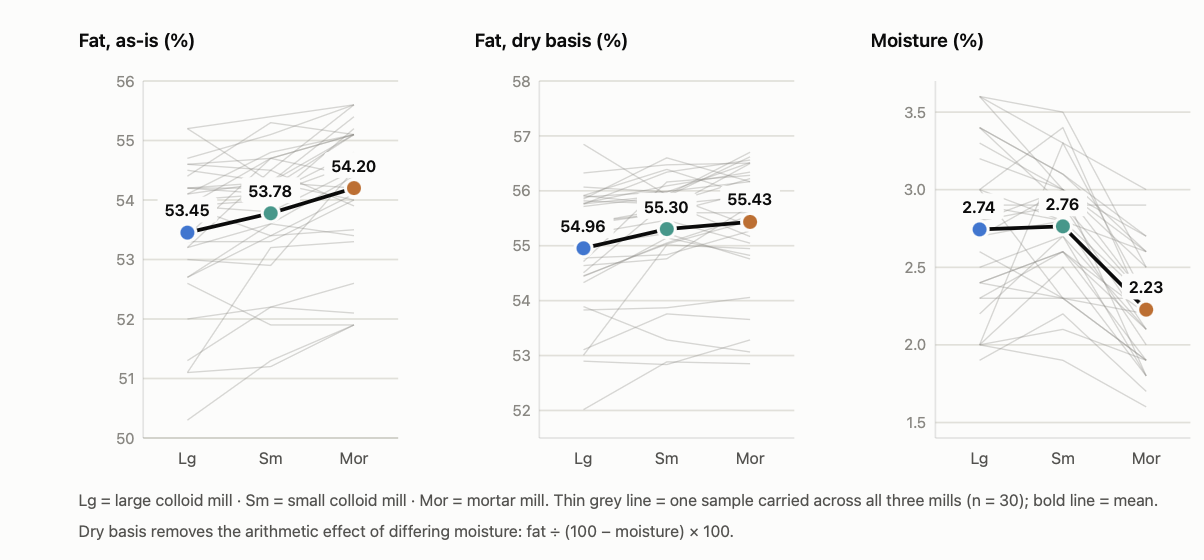
The variation shows differences from startup of equipment through to steady state - while you can't see it in the way I displayed it, there's clearly a progression of grinding to results in a 'startup curve'. The fat being measured is free fat, where the cocoa cells have burst and are leaking the fat out. The process neither destroys nor creates fat, but if it's not available (ie still in an intact cell), it doesn't help with viscosity reduction or flavor release, yet your'e still paying for it, so the goal is to release as much fat as possible w/o destroying flavor with heat or volatilization. I'd argue that the results are quite relevant, especially for moisture. There's a half a percent delta in moisture content, and moisture impacts *everything* including flavor. One of the interesting things about moisture is that as it leaves, it pulls other flavors with it - sometimes that's a good thing, other times it's less good. All of these have unimodal particle size distributions (at steady state, the startup curve shows similar differences in the distribution but evens out).
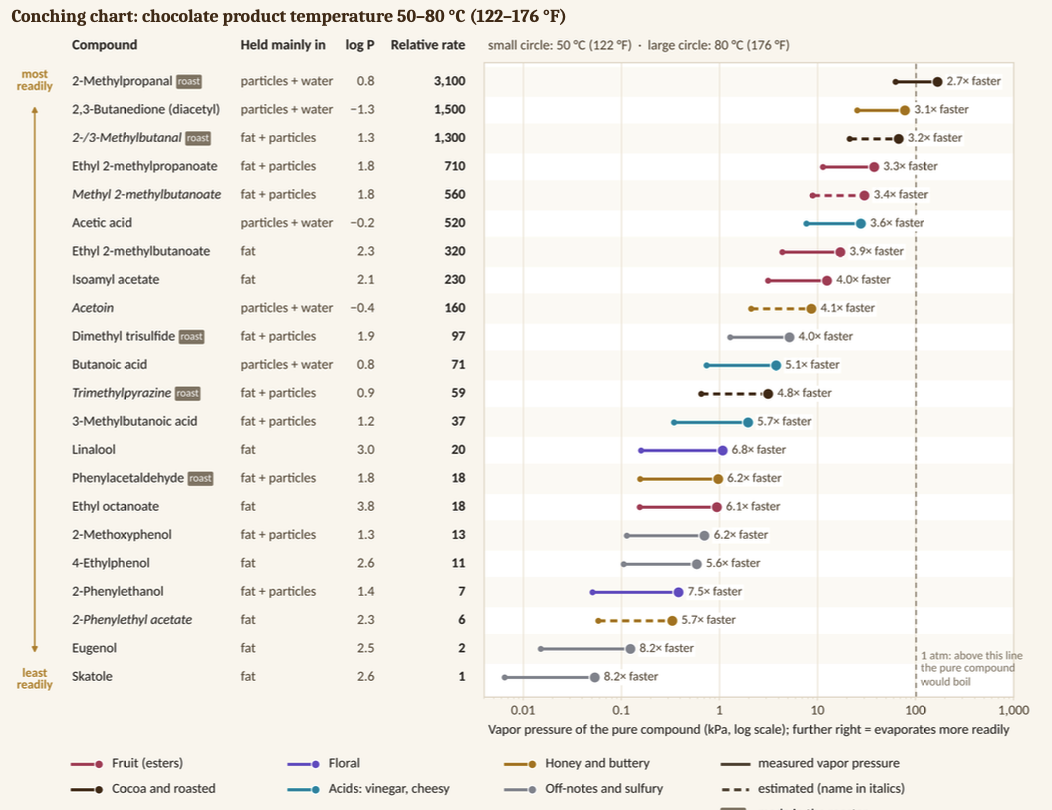
Below is an example of a flavor compound chart I made for someone recently as part of a more complex flavor management discussion. It may be quite hard to process without the accompanying discussion around the rest of it (this is only part of 1 page and there's 50 total pages walking through it) - but essentially read it as a series of both fat and water soluble flavors in chocolate over a range of coaching temperatures, and how easily they are or aren't driven off as a function of their boiling point and vapor pressure. Things at the top leave most easily and are the first to go, and as you go down the list it takes increasingly more energy to remove them. The scale is logarithmic.
Regardless of processing kit - it's almost always going to boil down to managing your temperatures, your moisture, and your airflow - as all of those things directly impact the retention - or destruction - of flavor compounds. Remember that almost all of the things you describe as flavor are actually aromas - there are very few 'tastants' (flavors that don't evaporate) - and aromas are, by definition - volatile - they evaporate - it's literally how you perceive them. The more energy you put into your system (be it from heat or air) - the more likely those things are to be removed. Remember that just because a system has separate healing and cooling circuits - that doesn't tell you anything about heat removal capacity. I've seen plenty of systems that have cooling capacity on paper, but in reality generated heat faster than the cooler could remove it - which means a net heat accumulation over time, or a higher heat plateau than desired once the cooling system maxes out.
If your question is can a ball mill match the output of a melange? hm. I'm not sure I have a good answer for you, other than to say that matching of products made on different types of equipment is usually quite difficult.
updated by @sebastian: 10/18/26 06:56:57