
Blogs
The Art of Chocolate. From the Finest Cocoa to Exquisite Chocolate. part 5
By Vercruysse Geert, 2011-12-19
Published by Max Felchlin AG, Schwyz, on the occasion of the 100th anniversary. (2008)
Since visiting Felchlin 2010 and2011, I must admit Im addicted to there chocolate and there philosophy. This book is to interesting not to blog, so I must share this on my blog.


The Bean From Harvesting to Shipping
The picked, ripe an healthy cocoa fruits are cut open. The beans are removed and transferred to wooden fermentation boxes that are not exposed to direct sunlight. This is the traditional and most authentic fermentation method; other modern methods, tailored to large-volume fermentation, are not as natural.
Fermentation Before fermentation, the beans are first inspevted and any rotten or mildewed beans discarded. Fermentation starts a maturation process, which involves microorganisms initiation the fermentation of sugar in the pulp, thus generation heat. The fermentation process kills the seedlings in the beans and relaeses an intense odour and juice runs out of the box. With wine, fermentation ends with cooling, however, with cocoa beans, it ends with drying. Experience gained over the centuries, as well as more recent experiments, have helped to determine the exact point when fermentation is over. Criollo, for example, has to ferment for between two or three days, Nacional for between four to five days and Forastero for between seven to eight days (depending on the hybrid). Experience is also necessary for controlled fermentation in boxes: the beans have to turned regularly to ensure sufficient aeration. Other factors that are key to successful fermentation are air humidity, temperature and the size of the boxes (area, height, width). The type and quality of the wood (soft, hard) also play a role.
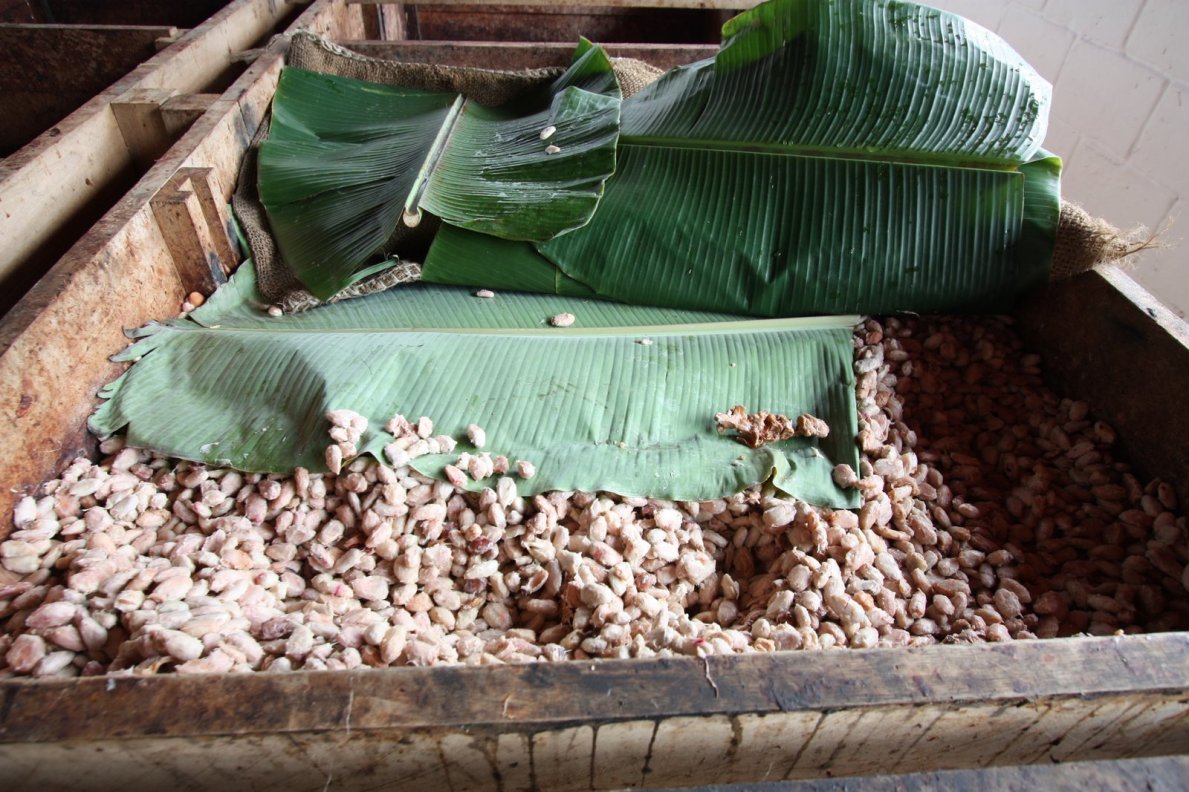

Drying After fermentation, the cocoa beans have to be dried with the shrivelled, dry pulp. The best method is a natural one of simply drying the beans in the sun. The fermented beans are spread out in shallow wooden trays or on racks covered with mats made of natural fibres; in the event of sudden rainfall, the mats can simply be rolled up. Drying has to be monotored continuously (almost a daily occurrence in the Tropics), or if the sun is too strong, the beans have to be covered quickly. Three days in the blazing-hot sun is dangerous as the beans are dry on the outside but still moist on the inside; this means that will later sweat, give off moisture and then go mouldy during transportation or in storage. Depending on conditions and variety, drying takes between three to eight days. When shipped, beans should not contain more than 6.5 percent moisture.
FERMENTATION METHODS
Fermentation is a natural, spontaneous process that has a major influence on the quality of the flavour of cocoa. By using suitable infrastructures and methods, its possible to control the process and thus the resulting flavour.
Unfermented : the beans start to ferment spontaneously in the transport containers but with no control whatsoever. They are then taken straight to the drying stage, which means that virtually no fermentation takes place. Quality: poor.
Piles : the beans are collected into piles, covered with banana leaves and then left to ferment spontaneously. No infrastructure is required; the process is difficult to control. Quality: moderate to good.
Sacks or baskets : the beans are left to ferment in transport sacks or baskets. Simple infrastructure; only suitable for small quantities. Quality: moderate to good.
Boxes : the beans ferment in wooden boxes and are periodically turned, aerated and checked. Good control; relatively expensive infratructure. Quality: good to very good.

Selection Buyers differentiate between different qualities of cocoa beans. Thes differences are nothing to do with the actual variety, rather they are the result of the preceding stages, from cultivation to drying. The qualities selected have different names, depending on the country of origin.
For example, in the Dominican Republic, the highest quality is Hispaniola; the buyer has a say in processing and can, for instance, have any beans that are too large or too small removed to ensure uniform roasting sesults: beans that are too small quickly burn and those are too large are not roasted all the way through. In the Dominican Republic, the poorer quality bean is known as Sanchez. Local selection is important as this is the only way to determine the quality. Although the flavour can be influenced at a later stage (roasting, conching), the basic quality cannot (bean variety and size, fermentation, drying).
Most chocolate producers buy cocoa from traders in Europe, for example, in Geneva or Amsterdam. However, Felchlin does things differently. The specialists from Schwyz travel to the place of cultivation, taking the long journey and sometimes arduous communication in their stride in order to buy the cocoa beans at source. This enables them to use their expertise, to astablish relationships abd exert a direct influence on the properties of the beans. This personal commitment has a positive effect on qulity and any variations are relatively easy to prevent.

DRYING METHODS
The fermented beans still contain approx. 60 percent water. This has to be reduced to less than seven percent so that the beans can be tranported and stored. Slow, careful drying is important for the resulting quality and can take up to seven days.
Sun-drying The beans are spread out to bamboo mats or wooden tables and, depending on weather conditions, protected from strong heat or heavy rains. Its easy to turn and move the beans and the condition of the beans and the drying process can closely monitored. However, a large amount of manpower is needed and the long drying time is weather-dependent. Quality: good to very good.
Artificial heat The beans are heated in long, deep trays by bloxwing air that has been heated artificially through a perforated base. There are also other systems for transferring heat. Large quantities can be dried quickly, even in poor weather conditions. However, drying is uneven, often forced and, in the worst-case scenario, the beans can be contaminated with smoke from the combustion facilities. Quality poor to satisfactory.

Next time: The Journey From the Farmer to Basel
The Setup
I was given the opportunity, earlier this week, to do the chocolate, wine, and beer pairings for a holiday party, co-sponsored by Valrhona, Fresh Direct, and Manhattan magazine, to whichover 200 people were expected to attend.
There are always challenges with doing large scale events like this, but the major hurdle for this particular event was that I'd never tasted any of the wines that were going to be served and it had been a while since I'd tasted either of the beers. I don't like showing up at the venue an hour before things are scheduled to start and having to the pairings on the fly but that was the way it had to be and my only option was to take a deep dive and do my best.
The six chocolates being sampled all come from the Valrhona Grand Cru bar line - Tanariva (33% milk), Jivara (40% milk), Caraibe (66%), Alpaco (66%), Manjari (64%), and Abinao (85%).
A Short Aside
In case you don't already know, I happen to be a contrarian when it comes to wine and chocolate pairings. I find it easier to find really good pairings between whites with dark chocolates and reds with milk chocolates. More generally, I find that the clich advice of red wine with meat, white wine with fish means you're unlikely to get real dud pairings. But because they're safe, you rarely get great pairings unless you really know what you're doing. By pairing outside the lines you're more likely to run into some real loser pairings but you're also more likely to run into really excellent surprises.
Because I was under the gun to do the pairings, starting out with the contrarian approach suited me just fine, and gave me an interesting angle to talk with the guests about - that a little bit of adventure is a good thing, and thinking outside the box can deliver some truly excellent experiences.
The Pairings
Tanariva - One of the two surprise pairing of the evening was the Tanariva with Brooklyn Brewery's Pennant Ale. This is an English Pale Ale, not an IPA, and has a warm yeasty/bready flavor - lots of roasty malt flavors with a nice soft bubble structure. These married very well with the sweet caramel notes of the Tanariva and created one of those rare situation where the pairing elevated both of the component parts. The paired wine was the 2009 Domaine Pelaqui Ctes-du-Rhne. This is a good mid-priced bottle that has definite bright acidity to it. This acidity made it unpleasant with all of the dark chocolates and the high milk fat content tamed the acidity.
Jivara - I also paired the Brooklyn Brewery Pennant Ale and the Ctes-du-Rhne with the Jivara. The beer pairing was not as sublime with the Jivara as the Tanariva because of the much darker flavor profile. However, the Jivara stood up to the Ctes-du-Rhne better than the Tanariva for the same reason.
Caraibe - The tasting notes on the Caraibe say balanced and voluptuous and it was this in mind that suggested pairing it with the 2009 Edmeades Zinfandel (California) after I got a chance to taste it - also a balanced, voluptuous Zin. This is definitely a go-to comfort pairing and just might be one of the all-around most pleasant red wine and dark chocolate pairings I've tasted in a long time.
Alpaco - The tasting notes on the box say floral and oaky and this made it a natural choice to at least try pairing with the 2010 Channing Daughters Scuttlehole Chardonnay (Long Island, NY). This chard is fermented in steel with no malo-lactic fermentation and there is no contact with oak. The wine is a straightforward expression of the fruit of the grape without any herbaceous or woodiness. The light floral notes of the chocolate accentuated the fruitiness while the oaky notes added a small hint of the wood we Americans have come to expect from Chardonnays, especially highly-rated Californian ones.
Manjari - This was the other really surprising winner pairing of the evening. The combination of Manjari - which is probably the best-known Valrhona chocolate in the professional kitchen - and the 2010 Salmon Run Riesling (Finger Lakes, NY) delivered the uncanny taste impression of a s'more or at least the combination of graham cracker and chocolate. Astonishing. There is nothing about the typical Madagascan acidity or the light sweetness of the Riesling (a little too sweet for my taste, while I like Rieslings I prefer drier ones in part because it's hard to get people who say they don't like Rieslings to even try them during tastings - almost as hard as getting people who say they don't like milk chocolate to try milk chocolate) to suggest that the pairing of the two would lead to graham crackers. This pairing was a lot of fun and had people smiling.
Abinao - At 85%, this is a chocolate that even dark chocolate-lover sometimes have trouble with. Neither of the red wines came close to being a pleasant combination, the Chardonnay didn't have enough character, and the Riesling wasn't sweet enough. Thankfully, we had the Smith Woodhouse 10yr Tawny Port and the mellow silky sweetness of the Port blended tamed the Abinao very nicely. This would be a very good dessert pairing for following a meal where steak was the centerpiece and you didn't want something too rich - or too sweet - for dessert.
There were two other beverages poured, Brooklyn's Brewery's Dark Chocolate Stout, and the Althea Prosecco NV (Italy). Prosecco is my go to all-around favorite pairing wine, especially drier ones (although there are some stunning ross). Proseccos have a tendency to be less sharp and alcoholic tasting than champagnes and also tend to have a softer, creamier bubble structure. This makes them excellent sparkling wines for general enjoyment. The best chocolate pairings were the Jivara, Caraibe, and Abinao. What to say about Dark Chocolate Stout but to say that it's a "no brainer" for most people when it comes to chocolate pairings. Overall, however, you want to pair a stout like this with chocolates that aren't particularly fruity or acidic. The Caraibe was the overall best pairing because of it's balanced flavor profile and luxurious mouth feel. The Jivara was next-best, but the Tanariva was just too sweet.
* Disclaimer.
I consult to the organizer of the party, Ciao Imports, on their chocolate program. Valrhona is one of the brands they represent, and Fresh Direct is now offering over a dozen items from Valrhona including Grand Cru bars and selections from the home baking line. The wines were provided by Union Square Wines, who is the wine provider for Fresh Direct. The beers were provided by Brooklyn Brewery.
Looking for Chocolate fillings with atleast 12 months expiry date.
Any suggestions??
Guys please suggest me how to increase shelf life of Ganache based chooclates?
I am planning to put chocolates in retail and want them to survive more than 6 months...suggestions please
Leonidas Confiserie SA is a chocolate producer with an international presence, based in Belgium. The company's focus is pralines (chocolate shells with soft fillings and marzipan, solid chocolates, and other confections. The company is named after its Greek founder, Leonidas Kestekides, a confectioner who moved from Anatolia to the United States in the late 19th century. The logo used on Leonidas chocolates shows an effigy of the Greek warrior Leonidas, King of Sparta.
Visit our Facebook and webpage at:
https://www.facebook.com/pages/Leonidas-Chocolate/180321615342183
http://leonidas-chocolates.ca/


We make about 800 truffles every year for Christmas presents and this is first time we tried molding them. It is so much easier and faster.
And did you know if you increase the recipe by 15%you get just enough ganache to fill two small round molds completely.
-Thanks,
Kevin Creedon
Tom Drahos of Windows on the Water and I, Tom Neuhaus, president of Project Hope and Fairness, are doing a Molecular Gastronomy demo at the SLO Botanical Garden in San Luis Obispo, Dec. 16, to benefit Project Hope and Fairness, a non-profit established to help cocoa farmers. Last summer, we donated $4500 of tools to cocoa farmers in Ghana and Cameroon. To learn more about the demo, see www.projecthopeandfairness.org and click on the last item in the Events box. To read about last summer's trip, go to www.sweetearthchocolates.blogspot.com .

Emmanuel Hamon, French Pastry chef hasjust won the contest of"The most beautiful Chrismas Log cake2011". contest organized by Macarons& Gourmandises (N1 French media and online dedicated to pastry / chocolate high end). For this second edition, Emmanuel Hamon did presented a cake entitled "Christmas in New York." Inspired by Manhattan, this log-colored taxis in New York buildings decorated with chocolate has learned surprised by its amazing design and originality. The competition was tough in the face offamous pastryhouses of Paris. A "Christmas in New York" will be offered to order a limited edition (80 copies).
The 8 th time I visited Le Salon du Chocolat in Paris. To be honest: I love it and I hate it. Its too big and too crowded. But I have to go because every year I find some very special things that makes the trip worth it. First I check which chocolatiers won the awards from Le Club Des Croqueurs de Chocolat. I mostly agree with their opinion. Five of the twelve best were at Le Salon: Pascal Le Gac, Vincent Guerlais, Jean-Paul Hvin, Sadaharu Aoki and ES Koyama. The last one I had not heard of before so I bought some of his chocolates. Wow, this is good!
If you are interested in small artisan bean-to-bar chocolate makers you have to go to London. But for chocolates-bonbons I think Paris is the place to go. Although the fillings are very traditional, they are of superb quality. Of the small chocolate makers we met in London only Bojesen was at Le Salon. The curious chocolate lovers you could find at his stall: Chloe and Evert-Jan. The Brazilian booth had also some interesting bars that I didnt taste before. So full shopping bags and an empty wallet when I left Le Salon.
Tasting could begin!


This was the first year of the Single Origin Event in The Netherlands. Hopefully this will be a yearly event from now on. The location was Restaurant Merkelbach in Amsterdam. The event was organized by Erik Sauer of El Sauco, distributor of some very beautiful single origin chocolates (yes also Original Beans!) and Erik Spande, owner of Chocoltl chocolate shop in Amsterdam. They invited Santiago (Pacari), Mott (Grenada), Philipp (Original Beans) and Kees (Metropolitan Deli) to tell the unique story behind their chocolate. And of course we tasted three different chocolates of each chocolate maker. Geert Vercruysse and his wife Katrien came over especially from Belgium for this event. Geert made some chocolate-bonbons filled with ganaches with Grenada, Pacari and Original Beans. Delicious and very beautiful! You can now buy them at Chocoltl. At the after party Marilla Erkens served a gorgeous vegan soup (based on cauliflower and other vegetables and spices) with Grenada nibs! Wow, that tasted really good!


