
Blogs
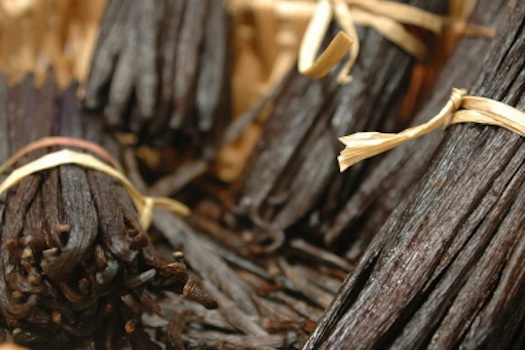
When you think about vanilla, you might picture the familiar brown bottle of extract next to a bowl of butter, eggs, sugar, eggs and flour. Chances are you can practically smell the vanillas potent fragrance -- warm, earthy and resonant with cherished memories of cookies past. If you were to taste a pinch of the cookie dough, you would notice the completeness vanilla provides the sweet brown sugar and rich butter . But describing the actual taste of vanilla is not easy. Its aroma is deep and earthy, but theres nothing musty about it. Its not floral like a rose or citrusy like a tangerine. We know vanilla as an important flavor component in irresistible sweets, but by itself, vanilla is not sweet at all. What, exactly, is vanilla?
A flower, a fruit, a bean, a mystery
Vanilla comes from a rare, light-green flowering orchid native to southern Mexico - the same region in which chocolate was first cultivated. The climbing rain forest vines sprout delicate blossoms, which then turn into long seed pods. The vines grow in the shade of large, leafy tropical trees like cacao and banana, deep in the forests of Guadeloupe, Indonesia, Madagascar, Mexico, Reunion (an island that's a French territory in the Indian Ocean) and Tahiti. The orchid flowers blossom briefly, and once pollinated, nine months pass before the seed pods reach maturity. When these seed pods are harvested, dried and cured, they become the dark brown beans from which we derive our vanilla (the seed pods are referred to as vanilla beans because they resemble green beans). They are sold in bundles and graded for quality.
One of the reasons vanilla is rare is because the flowers blossom only one day a year, and only for a few hours. Many orchid varieties exist throughout the world (more than 35,000 different kinds!) but only one produces edible fruit -- the vanilla planifolia. The flower can only be pollinated naturally by the tropical Melipona bee or a few species of ants and hummingbirds native to Mexico. Since these species evolved together, the insects and birds understand that they must approach the flower at exactly the brief moment it is open. This kind of restriction does not make cultivation easy, so today, vanilla farmers pollinate the flowers by hand. Once the pod ripens on the vine, it must be carefully plucked so that the base of the flower can generate new blossoms and thus, new pods. The seed pods are then dried on mats under the tropical sun, carefully steamed, turned and dried again.
The high demand for vanilla from industrial food producers, perfumers, home cooks, extract makers, cigar makers, soda companies and liquor manufacturers outstrips regional farmers abilities to produce enough vanilla beans. Synthetic vanilla (called vanillin, which confusingly enough is also the name of the chemical compound that gives real vanilla its flavor) is made from clove trees, waste paper pulp or coal tar. While the synthetic version of vanilla is widely used in mass production, it is inferior to natural vanilla, especially for premium culinary and aroma therapeutic use.
The finest vanilla in the world is still harvested in Mexico because of the growing conditions necessary for this timid orchid to thrive, and perhaps because a connection still exists between the Mexican people (particularly descendants of the Totonac tribe) and the native fruits of their land. The capital of vanilla production is Papantla in Veracruz, also known as the city that perfumes the world.
How to buy and split vanilla beans
The spice section of many grocery stores now carry vanilla beans, usually packaged in airtight glass vials. Look for beans that are dark, plump and shiny, not dried out. Other sources include Surfas in Los Angeles, or online: Vanilla Store , Nielsen-Massey Vanillas , Rodelle Vanilla or Boston Vanilla Bean Company . (Online prices are usually less expensive.)
To get the seeds out, place the vanilla bean on a cutting board and hold one end down with one thumb. Puncture the top of the bean near your thumb with the tip of a sharp knife and slice it all the way down, then pry the pod open with both hands. Next, hold the bean down at same spot with your thumb, split side up, on the cutting board. With your other hand, hold the paring knife with the back of the blade pressed down on the inside of the pod and scrape all the way down. The sticky black little dots that collect on your knife blade are your precious vanilla.
Making your own vanilla extract
Making homemade vanilla extract is a snap, and this version, which uses dark rum in addition to vodka, produces a rich, fragrant extract with intense depth of flavor. Take a large mason jar (16 ounces) and fill it halfway up with Myers's Dark rum. For the other half, use a vodka of your choice. Take 10 vanilla beans, split them, remove their seeds, and place both the seeds and the seed pods into the rum and vodka mixture. The chemical process necessary to remove the full flavor from the pods takes about three months. Store the jar in a cool, dark spot and shake it occasionally as you wait for the flavor to emerge.
To replenish your extract supply, you can re-purpose any vanilla beans you use for other recipes such as custards. Simply rinse them in warm water, dry with a paper towel, and place them back into the jar of extract. When the jar is halfway gone,, just add a half and half mix of rum and vodka to replenish the alcohol. By consistently replacing the vanilla and alcohol, you can keep the same jar fragrant and ready to use indefinitely.
Article from Zester Daily ( www.zesterdaily.com ); Photo: Good-quality vanilla beans make wonderful homemade extract. Credit: Yula Zubritsky
Enjoying a new blend of flavors...goat cheese and balsamic ganache
By Gretchen Tartakoff, 2010-04-04
Participating at the local Chamber of Commerce Women in Business fundraiser, I beta tested the results and there was no competition with the traditional ganache....everyone came back for the goat cheese ganache frosted cupcakes~it fits very nicely under the savory and sweet recipes too.

It was my first tasting "for official purposes".
To address the invited representatives of several European countries I've decided
to present 7 European chocolate manufacturers and, in order to reveal the
appeal, uniqueness and variety of chocolate, to choose 7 single origins from around
the world. The most difficult task was to mach them in an appropriate way.
The next difficult task was to get all these fine chocolates. Not really easy
to a traveling friend, unfamiliar with these things to get some bars for me in
Brussels, Berlin or Hamburg, even if I did all the research and gave proper
instructions. The chocolate variety might be really overwhelming! Ordering in
an online shop seemed to become quite an expensive matter, for it wasn't
possible to find everything you need at one place... And who wants to spend
more on shipping than on the chocolate itself?
A lucky accident let me come across an owner of a great shop in Hamburg
which even hasnt got an online shop. But she was ready to help me, anyway, and
just couldn't suggest one sort of 7 (the only one I could get here, in Lithuania,
isnt this lucky?!)
The result then looked like this:

- Panama with Zotter, Austria, 40%, milk
- Papua New Guinea with Zaabr (which works with Callebaut) Belrgium 64%
- Java/Highland Jember with Betty Daring, which works with Felchlin, Switzerland 64%
- Vila Gracinda/Sao Tome with Michael Cluizel, France 67%
- Venezuela/Sur del Lago with Domori, Italy 70%
- Jamaica with Coppeneur, Germany 72%
- Congo/Monts de la lune with Blanxart, Spain 82%
Our tasting plates looked like that:


Since I didn't know about chocolate bias of our guests, I did my best to design the tasting to be entertaining..
It was the right way to let them riddling about where could the chocolate could be from
etc. I showed the packaging and commented on particular orgin or manufacturer only after everyone had made his or her mind.
I was really glad to have very curious tasters - everyone seemed to have fun
discovering, this included aso taste nuances and differences. And one should have seen these glad smiles when a chocolate from the home country was appreciated by the fellow tasters. Well, I really did my best presenting every country from its chocolate side.
The favorites were (alphabetically):
Congo,
Jember
Vila Gracinda.
The guests were happy, so was I. After the preparation stress ("my
goodness, I haven't been speaking advanced English for ages...will I manage to
speak fluently enough and finding right expressions not loosing my plot")
I enjoyed the event quite a lot. The communication was great, there was
vivid interest, and there were lots of questions (all of them - and it is also quite
important - I could answer), there were smiles and new ideas...
Crossing Max Brenner's off my list, I went back to what I knew... Naked Chocolate Cafe. Right away I noticed a difference in quality. I've never seen chocolate shine this much. And despite it being dark chocolate, there was no grit at all. I had a tiny cup of sipping chocolate. That's basically melted chocolate with a spoon. I was quite pleased, though it was hard for me to tase anything specific. I think that's because it was crowded, and noisy. Or maybe my palette wasn't properly cleansed from the pretzel I ate before it. I couldn't taste any notes other than chocolate. I'm not sure if some chocolate is just like that, but I think I prefer that to certain notes - fruity ones particularly. And I expected the dark chocolate to have a stronger flavor than the milk, but I don't think that's necessarily the case with this drink.
I bought a chocolate bar to bring home with chocolate nibs on it. I don't know what nibs are, but I'm excited to find out! I'm saving that one for Easter.
ChocoVision introduces the capacity-increasing Holey Baffle for commercial units
Poughkeepsie, NY February 2010 ChocoVision, manufacturer of innovative chocolate processing equipment, has announced the latest advancement for the Revolation X 3210 and Delta chocolate tempering machines; the Holey Baffle , which increases their chocolate capacities from 10 to roughly 18.5 Lbs.
The advantage this new Holey Baffle brings begins with a series of strategic louvered openings that allow chocolate to flow throughout both (the probe and non-probe) sides of the bowl. There is no compromise to the tempering process while nearly doubling the capacity of both the Revolation X 3210 and Delta units.
Along with the capacity increase, ChocoVisions Holey Baffle provides substantial performance improvements due to more direct heat reaching the entire pool of chocolate at all times.
I was skeptical about this new Holey Baffle after speaking with industry authorities because none had heard of anything like it being done before, stated Joe Crevino, ChocoVisions Chocolate Consultant and New Products Beta Tester, but the Holey Baffle indeed doubled my machines capacity and maintained the chocolate in perfect temper.
ChocoVisions new Holey Baffles are available for immediate shipment at the low introductory price of $99.00 (retail price will be $199.95 ). Please contact sales@chocovision.com , visit our website at www.chocovision.com , or call (800) 324-6252 to order yours today.
Double your capacity, not your budget!

Lets start with the old master. Nestled between the luxury boutiques flaunting fine lingerie and crazy haute talons, <a href="www.chocolatmichelcluizel-na.com "><span style="font-weight:bold;">Michel Cluizel</span> </a>(201, rue St.-Honor) has been making chocolate since 1948, though his daughter Catherine now manages the store. Among the delights for you to discover: a wall-mounted fountain spewing molten chocolate, giant bowls filled with truffles and macarolats (a chocolate version of the macaron) and 99% cacao chocolate bars. Pas mal!
Further up the street is <a href="www.jphevin.com "><span style="font-weight:bold;">Jean-Paul Hvin</span>s</a> modern and refined tea salon/chocolate shop (231, rue St-Honor)top 3, if not my very favorite, chocolatier. Dainty macarons and pretty cakes welcome you along one wall (or you can indulge upstairs in the tranquil salon de th), but the bonbons are hidden in the back. With cocoa sourced from Venezuela, Ecuador, Colombia and Madagascar, and ingredients like cinnamon, caramel and champagne whipped into the dark chocolate ganache, theyre nothing if not sublime.
The selection at <a href="www.pierreherme.com"><span style="font-weight:bold;">Pierre Herm</span>s</a> 4 rue Cambon boutique is more limited than at rue Bonaparte, but dont despair. While you wont find towering cakes like the Plenitude or Isaphan, you will find all the incredible macarons and chocolates your heart might desire.
Finish off the decadence by sitting firmly on your butt at Angelinas (226, rue de Rivoli). You might have to battle some tourists and none-too-friendly waitresses for a seat, but a pitcher of their chocolat Africain more than makes up for it. Its rich and chocolaty, smooth and velvety, thick enough to coat your tongue, and almost thick enough to stand a spoon up in it. Its, oh whats the word heaven?
Any other places I should include? For those with more than one shop, is there a particular location I should visit? Is it feasible to walk the whole way or should I plan on taking the Metro? Helpful chocolate vocabulary? Thanks!
So, I went to Max Brenner in Philly for the first time, today. I decided I'm going to try to review what I have their. That way I can keep track (have something new every time), learn about chocolate, and feel like I have a good excuse to spend that much money on food.
I ordered an italian thick hot chocolate. It comes in one of their hug mugs (that doesn't have a handle, and is more wedge-shaped than round). I expected it to be really thick, like sipping chocolate (basically a melted chocolate bar), but it wasn't. It was thicker than regular hot chocolate, but I think that was due more to the cream in it.
I got the milk chocolate (other choices were dark, and white). It came very hot, but I was able to sip it with my spoon. Very smooth, warm flavor, that reminded me of chocolate pudding cake straight from the oven. Know how chocolate baked goods have that different flavor when they're hot enough to give you a severe burn? It had that quality, which I enjoy thoroughly.
But I was so excited to try using the hug mug for what it was designed for. After being burnt once or twice (I have a lower tolerance for heat than most people), it was finally cool enough that I didn't have to hold it on the wedge-shaped plate it came on. So, I sipped the warm, creamy drink, and was happy with the result.
Though it wasn't the most chocolaty drink, I thought it was very pleasantly flavored. If I try the italian thick hot chocolate again, I'll go for the dark, to see if it has stronger flavor.
For about $6 plus tip, I thought it was worth the try.
What next? Maybe the truffle, I'm not certain yet.
Has anyone else had this? What did you think about it? Is there something out there that's like this, only better? Share your thoughts! Blogs are no fun without comments!
I live in the tropics - Trinidad - where some of the world's best cocoa beans allegedly come from and have quite a bit of cacao trees on the land left from a time that Cadbury owned the entire area. My husband and I decided that it was time to rehabilitate the existing trees and replant new ones and we ended up with quite a bit of cocoa pods. the seeds were picked, fermented and sun-dried in our good, HOT and dry weather that we are experiencing now and we ended up with about 100 lbs for the first set.
I decided to try a home made batch. I roasted the beans on my stove top and shelled them after finding a recipe on line for 80% dark chocolate. It was fairly simple - put 8 pts beans and 2 pts sugar in a grinder and grind. Well, I used my Magic Bullet, but it seems to be on the way out (and now I think it's dead). I added some mexican vanilla, cardamom, a pinch of nutmeg, and some cinnamon and tried to "mortar and pestle" it. The end result was quite good - a chocolate with a nutty flavour and not too bitter. It formed a good bar that was pretty tasty! But all in all, better for making hot drinking chocolate.
Now I need some proper equipment for my next try. Any suggestions for me?