
Blogs
It's true, cocoa paper is made by hand using traditional methods.
A team of 6 make an astounding 40,000 sheets of cocoa paper a month! We have many more skilled paper makers eagerly waiting to join our team and double or even triple that number if sales increase.
Watch this short video to learn how cocoa paper is made.
I'm excited to announce that you can now buy Cocoa Paper products online!
Cocoa Paper is handmade using sustainably sourced cocoa tree bark and recycled white paper. For all our home and office stationery needs visit: http://www.cocoapaper.org/
Feel good about supporting cocoa sustainability. 
The Art of Chocolate. From the Finest Cocoa to Exquisite Chocolate. part 7
By Vercruysse Geert, 2012-01-25
Published by Max Felchlin AG, Schwyz, on the occasion of the 100th anniversary. (2008)
The Transformation From Bean to Chocolate

The fermented and dried cocoa beans are packed in sacks made of coarse jute and shipped across the ocean. They are then transported along the Rhine and unloaded at the port in Basel and put into storage. The chocolate manufacturers small warehouse in Schwyz only has the capacity to hold the quantity of beans that are used on a daily or weekly basis and that will be processed in the near future. Howover, before storing, Felchlin carries out one final, quasi inhouse grading of the delivered goods, separating them into two groups: those that are to be processed into Grand Cru chocolate and those that will become a blend of various origins.
Cleaning The daily quota is stored on pallets next to the cleaning machine. In industry, the cleaning process is fully automated, however, with a small producer of top-quality chocolate such as Felchlin, a single individual performs the first step in the cleaning process, which takes place in four stages, using three machines. This individual cuts open the sacks and casts a watchful eye over the contents as they are poured into the cleaning facility. This inspection is the last control before processing; after all, the cocoa beans could have become mouldy during the long sea passage in the ships hold. If the sacks were emptied automatically, this deterioration would go unnoticed with disastrous consequences for the final quality.
During cleaning, a magnet first removes any bits of metal. A blower then extracts dust and dirt, wood and fragmented beans. Finally, using a combination of gravity and vibration process, everything thats heavier than the cocoa beans is removed from the machine, for example, small stones. The cleaned beans are then transferred to a funnel-shaped silo and, from there, fed via an intermediate silo into the reactor below, where they are sterilised: pressurised, hot steam at a temperature of 150-170C kills all germs in just three to five seconds.

Roasting In the production of first-class chocolate, roasting the cocoa beans is equally as importants asfermentation. Roasting reduces the water content of the beans from about 6.5 percent to about 2 percent; the shells loosen, the colour darkens and the roasting aromas develop. Traditional drum roasters, such as are used at Felchlin, may appear outdated but thanks to their size, they are easy to monitor and handle; this enables rapid intervention in the roasting process. These traditional drum roasters are gas powered (of course, everyone is familiar with the immediate respones time of gas to simple manual adjustments from experience in a domestic kitchen). In order to achieve a uniform roasting, the beans are turned and mixed continuously in the drum and then discharged and fed into the cooler below. At this stage, a cocoa bean would not taste very different to a coffee bean to a certain exent, coffee and chocolate contain the same active ingredients; on account of its 50 percent cocoa butter conten, the cocoa bean is softer and without aroma.
More on Roasting:
Roasting pan: Open metal container that is heated over fire. This method is sometimes still used in the countries of origin when roasting cocoa beans for local consumption. (use: domestic)
Drum roaster: Large, rotating, gas-powered metal drum. The cocoa beans inside are moved and turned continuously for gentle, uniform roasting. This roasting in portions enables the roasting master to monitor the process and to quickly adjust the process to the different properties of cocoa beans depending on harvest and origin). (use; manufacturing)
Continuous roaster: Long, ventilated channels through which, from the left and right, hot air is blown. The channel is filled with cocoa beans or nibs, which slowly move from top to bottom and are thus heated continuously. The method is suitable for fully automated roasting of large, homogeneous quantities (mass production), but not if small quantities of different vareties have to be roasted. (use: industrial)

picture source: Vera Hofman.
Cracking The roasted, cooled beans are then fed through pipes into the winnower, where they are cracked and shelles removed: two rollers with blades attached rotating in opposite direction break down the beans. This is followed by separation: the shells are then removed by suction and the cracked beans, now called nibs, are sorted on a vibrating screen in stages, starting with the first fraction (very coarse), then the second to fourth fractions (increasingly fine), all of wich are further processed into high-quality chocolate; the fifth fraction (1-3 percent of the total cracked volume; very fine, almost dust-like, with remaining residu of shells and foreign matter) is discarded and can be processed into animal feed. The nibs are then directed into a silo using a jet of air.

Grinding The stone mill has round, rotating, horizontal stone plate, which grinds the nibs to a particle size of 100 microns, without any loss of aroma (in contrast to high-performance machines). The heat generated melts the cocoa butter. Tasting the warm, liquid cocoa mass would now reveal coffee and roasted flavours, as well as very fine, barely perceptible hints of fruit (minimum acid). In the ball mill, the mass becomes even more liquid. All small particles of cocoa have been ground and the cells have unlocked their flavours and aromas. The fruit notes are now stronger on the palate; there is an earthy aroma and a long finish. The desired complexity gradually starts to unfold in the cocoa mass. With industrial production, the next step is neutralisation, which involves water vapour releasing acids and bitter substances from the cocoa mass; for most Grand Cru qualities, this intermediate step is unnecessary. After fine grinding, the pure cocoa mass is ready.

Mixing Transformation of the cocoa mass into chocolate starts in the mixer: additives such as granulated or raw sugar, vanilla powder (not vanillin but ground vanilla pods), milk and/or cream powder and cocoa butter are blended with the freshly made cocoa pass. Sugar enhances the aromas; vanilla does not taste like vanilla but actually makes the chocolate smoother. Although as it often conceals any flaws in the flavour. If the cocoa mass is further processed into Grand Cru quality, in order to maintain the pure character of cocoa, vanilla is often omitted.

picture source: Vera Hofman.
Rolling The additives have transformed the cocoa mass into a chocolate mass, which is ground in the two-roll refiner to a particle size of about 120 micron; any sugar cristals still present in the mass after mixing are pulverised; the mouthfeel of the mass is dry and coarse. The five-roll refiner determines the fineness of the future couverture: for a Grand Cru, this should be between 12 and 15 micron. The human tongue cannot detect particles finer than 20 micron; any grittiness has disappeared. The chocolate mass is transferred to a trough, where the first roll picks it up and draws it into the rolling system, which now rolls the mass with an upward motion until it is wafer thin: on the uppermost roll, the chocolate mass has the appearance of a thin, brown, almost transparent film covering the metal. The cooled mass then flakes of and the flakes enter the conching process.

Conching This is the key process in refining chocolate; it was invented in 1879 by Rodolphe Lindt from Bern. Conching releases the very finest aromas in the mass and takes place in three stages: dry conching, plasticising and liquefying. Depending on the recipe and the machine, conching can take anything from a few to more than 70 hours. The temperature and frictional effect are generated by a type of agitator or mixer or by rolling in the longitudal conch. The most delicate couverture has to be monirated carefully; its often the worker at the machine who decides when a process is finished and when to intervene. Today, state-of-the-art, fully automatic conches are generally used. However, the best flavour is still achieved with longitudinal conches similar to those used in the nineteenth century. With dry conching, the flakes of chocolate mass are heated frictionally to between 60 and 90C. The dark brown, rather dry mass is turned and sirred. The rise in temperature causes the water to evaporate and this rising water vapour removes any volatile substances, such as acetic acid produced during fermentation. The mass has an initial water content of approx. 1.7 percent; this is reduced to just 0.6 to 0.7 percent.

During plasticising, the dry particles are covered in cocoa butter during constant stirring; the mass takes on a silky gloss. The senses now come into play with thr eyes making visual assessment of mixture. The aromas should unfold and merge; this is checked every three to six hours. The fine gloss starts to from. Once the desired gloss has been attained, liquid cocoa butter is added to liquefy the mixture. Before further processing, the warm couverture is then poured into heated tanks and stored for a maximum of two days.
The longitudinal conch In simple terms, conching transforms chocolate mass into a gorgeous product. The longitudinal conch is the most effective conching tool and, with its gentle action, it allows the most delicious flavours to develop. Felchlin still uses three longitudinal conches, each with four troughs and rollers, manufactured in the 1930s by U. Ammann in Langenthal. Thise conch looks rather like a paddle steamer and operates in much the same way: the wheel moves two horizontal connecting rods, one in front and one behind. The wheel rotates in the centre of the machine; the cast-iron troughs are located on either side. The lids used to cover the troughs are curved and painted a milk-chocolate brown. A steel roller is attached to the end of the connecting rod and this rolls the chocolate mass eveny backward and forward over a granite bed. The troughs are not heated; the intense heat that, depending on the duration of conching, is generated at the pedestal is the result of this motion, the constant friction and rolling action. Crashes and bangs can be heard as the mass smacks into the corners under the lid. However, the roller must never jump or knock. It is crucial that the right temperature is attained and this is no mean feat. There is no skill in simply pushing a button to start the heating process, however, there is an art to generating heat by applying just the right amount of friction. With longitudinal conches, it is possible to generate a temperature of 75C or more; 60-70C is the minimum. A certain temperature must be reached after 24 houres; if this does not happen, it cannot be corrected.


More on conching:
The conching machine is a special agitator for refining chocolate. Both physical and flavour-forming processes take place that are extremely important for glaze and aroma of the chocolate.
Slow conching: in the mechanical longitudinal conch, the chocolate mass is slowly rolled and aerated between granite stone and steel rollers for two to three says. The frictional heat has liquefying effect without any loss of the delicate aromas and fruit acids (see figures above).
Rapid conching: modern method that prepares liquid chocolate in just a few hours. Agitators with large shearing forces and rotational speeds can be used for rapid stirring, heating and the cooling of the mass.

Summer of 2011 visiting Fechlin and admire the longitudinal conching, thanks to Sepp and his wonderfull team.
Tempering The finished couverture to be moulded is cooled from 45-50C to 26-28C in a tempering unit and then re-heated to 29-32C. This produces uniform crystals in the couverture, which give the chocolate the desired texture and appearance.
Moulding, cooling and packaging The liquid, tempered chocolate is poured into the mould, cooled, knocked out of the mould and wrapped in compound foil or put into bags and then packed in cardboard boxes.

The presentation of the Grand Cru couvertures of Felchlin in my shop, sold in drops and bars with details to learn about and why this is such a fine chocolate!
next part: The Composition Every Detail Counts.
More on Felchlin and conching find out at chocolate friend Vera Hofman
Found this nice mail few weeks ago in my mailbox, like to share it.

The Art of Chocolate. From the Finest Cocoa to Exquisite Chocolate. part 6
By Vercruysse Geert, 2012-01-12
Published by Max Felchlin AG, Schwyz, on the occasion of the 100th anniversary. (2008)
Since visiting Felchlin 2010 and2011, I must admit Im addicted to there chocolate and there philosophy. This book is to interesting not to blog, so I must share this on my blog.
The Journey: From the Farmer to Basel.

After selection, the dried beans are generally transported as bulk goods in the hold of the ship (for example, cocoa from the Ivory Coast) or, more rarely, in sacks, and then taken on the long journey to their destanation for further processing, for example, to Switzerland. In the most cocoaproducing countries, the ships dock in special ports that are sometimes named after the cocoa that is loaded there. One example of this is Maracaibo, a port in Northwest Venezuela between the Lago de Maracaibo and the Caribbean Sea.

Beans from Beni in Bolivia have a particularly long journey. First of all, they are shipped about 1200 kilometres along the waterways in the Amazon Basin to the nearest town and, from there, along the first mountain pass through the Andes to La Paz, the capital of Bolivia, which is located at an altitude of 5200 metres above sea level. From La Paz, the journey continues across the Altiplano* and the second pass through theAndes, about 4300 metres above sea level, and then down to the Pacific Coast as far as Arica in Chile. After travelling a total distance of some 1600 kilometres by road, the beans are loaded onto ships and taken northwards along the coast via the Panama Canal and finally 12600 kilometres across the Atlantic to Rotterdam or Amsterdam, where the containers are transferred to a freighter and carried a further 850 kilometres up the Rhine to Basel. In Basel, the ship arrives in dock I. Here, the cargo is unloaded and the valuable sacks loaded onto pallets and stred in a warehouse until it is time for further processing.
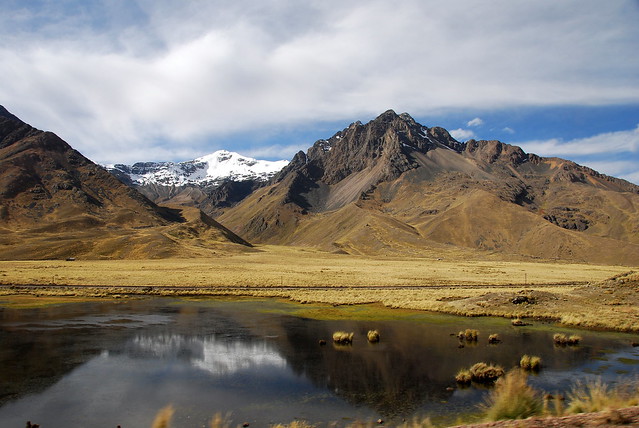
*Altiplano: a plateau of the Andes, covering two thirds of Bolivia and extending into S Peru: contains Lake Titicaca. Height: 3000 m (10 000 ft.) to 3900 m (13 000 ft.)
Depending on weather conditions, the journey of the Beni beans takes two to three months and covers a total distance of more then 16000 kilometres; this is about 40 percent of the circumference of the globe. During this long journey, the fermented and dried cocoa beans are subjected to several changes of temperature and climate: from the warm, humid air of the Amazon Basin to the cold, dry air of the Altiplano and Andean passes; from the damp sea-air of the Pacific to the warm, humid air of the Panama Canal and, finally, a long cooling period crossing the Atlantic. The 6.5 percent moisture content of the beans after drying has to be maintained at all times. The beans always need sufficient air. They are transported in jute sacks or in sacks made from plasticised, air-permeable fabric. In containers, the beans can sweat, irrespective of whether theyre packed in sacks or as bulk goods: the containers are lined with corrugated card and paper to absorb any condensation. When carried along the Rhine, they are occasionally aerated by opening the sliding roof above the hold.

AMAZONAS RIO BENI IN BENI BOLIVIA

Hello, am interested in purchasing used cheap bean to bar chocolate making machines. send me prices.
my e-mail is ssembuya@yahoo.com
First off, I have to say I've been remiss in writing this post, as we did a self-guided tour of Clay's recommended spots back in late October, but I have to give him credit for what was an absolutely awesome 3 days. Clays' recommendations greatly expanded the list we had and he helped make it one of the nicest trips we'd ever been on. We got to nearly all his recommended spots, and here are my own throughts about the places we visited:
- Pralus: Loved it. Love their little bundle of 10 50-gm single origin bars. (Perfect for "portion control, too!). Bought a lot of stuff here -- all fantastic.
- Pierre Marcolini: Small ganacheswith very diverse andoutstanding flavors and the staffcouldn't have been more helpful.I found myself liking the smaller pieces, too. Let's me try more at any one time.
- Victor et Hugo: Smaller variety, but very intense chocolate. LOVED the "hardcover book" box they came in. (Had an elastic strap and all, and I pictured myself keeping this one and re-using it to safely take chocolates with me when traveling.)
- We didn't spend much time in Michel Cluizel, Richart,or La Maison du Chocolat, as there are shops here in NY, and we wanted to devote our time to new places.
- Michel Chaudun: incredible truffles. Period. Other selections also good, nothing bad about this shop, but the truffles stood out. This was our last stop on one day, and the cashier saw all our little bags from all our stops and was even kindenough to offer us a large bag for all of them. We'd dropped a reasonable bundle at the place, so we didn't feel too embarrassed.
- La Chocolaterie Jaques Genin: DON'T MISS!!! There was NOTHING I didn't like about this place. The pastries were top drawer and if I were moving to Paris I'd want to live next door to his shop. The chocolates are packed in tins that are flat as a pancake but they're fresh as can be and I found them to have layers of flavor and notes. The staff were helpful and friendly. Also --normally, I can take or leave caramels. Take them home. They're about 1 Euro apiece and worth it. I had never tasted a truly fresh, made-last-night-right-upstairs caramel and these were the best anywhere. The smoothness was almost indescribable and there were about 10 different flavors. Plain and ginger were personal faves, but that's nit-picking. The guy knows his caramel -- and his chocolate.
- Sadaharu Aoki: OK, of the places we visited, this is one that was interesting, but probably one I wouldn't visit again. The chocolates were displayed like art pieces and looked very good. Most of the chocolate flavorswere Asian-inspired (yuzu, etc.) and I'm definitely glad we went, but once was enough. The chocolates were good to try but didn't leave me wanting more.
- Christian Constant: We'd visited here before and the best is their wide selection of single-origin bars. There's a cafe that normally has fabulous pastries but it was closed the day we went and even the case of chocolates was a bit sparse and missing some selections. We returned this time because our experience was very good at the first visit a year or so ago, and I'd recommend it. We probably just hit it on an off day. It happens.
- Pierre Herme: Pastries that belong in the Museum of Modern Art. Chocolates from a master. Lines always out the door and justified. Enough said.
- Patrick Roger: Terrific chocolates, fantastic selection of bars, with varied origins and percentages, and I bought a lot of them.If you like chocolates filled with marzipan, this place hadgood ones. Not my thing personally, but there was a good diversity of flavored ganaches. A good stop.
- Chocolate Jean-Paul Hevin: Another good place for bars.
- L'Etoiloe d'Or: Clay sindicated that this place was considered the best chocolate shop in the world. We liked it very much, but that's a high bar to set. Smaller selection of chocolates, but very good, LOTS of stuff to look at, bars, etc., and the non-English speaking staff was SO NICE! I'd say this was the HAPPIEST shop we visited and I'd be happy to return.
- Cafe-wise, we hit Laduree (always a mob) and Jacques Genin as indicated above, didn't hit Angelina this time, but we loved -- loved Patisserie des Reves. Smallsit-down place in the back and we had to wait and it was worth it. The pastries displayed in thre front of the shop are a whole scene, each selection either raise or lowered on a fancy pulley or in cases embedded in the wall. Fantastic cafe.
I should say that, while this was a lot to do, with a lot to eat,in three days, we WALKED the entire trip. It was about 8 or 9 miles each of the first two days, with less walking the third day, which was Sunday, so fewer shop were open.
Interestingly, other than a pastry each day, we didn't actually eat a huge amount of chocolate. We sampled, but didn't overdo it. Instead, we tended to buy things to bring home (bars, in my case!) to savor. of course, all the places we visited were expensive. This was absolutely NOT chocolate to be gulped, and I don't like to do that with chocolate anyway. My chocolate philosophy is to buy the best you can and savor it, or wait until you can. Less is more when it's really good.
I'd recommend such a trip to anyone, and even better if you can go on one of Clay's trips, do it. We didn't hit the restaurants where he did his chocolate and wine pairings on his trip, but one has to save SOMETHING for next time!
Cheers!
Keith
the creation of a product can be one of the most exhilerating experiences
By Paul John Kearins, 2012-01-01
in my 20 plus years in the chocolate and pastry world I've put out quite a lot of what some may call innovative stuff.... being my bread and butter I'm often too 'at work' to realise what exactly it is I'm doing and have achieved....luckily I realise that and have made a conscious effort to enjoy the experience of creation because let's face it , that's the whole point of it in the first place, right?
In my outside the box way, what recently began as a joke between a Maryland Chef and I on my facebook food group, rapidly fired my imagination to the creation of a concept/product that has me awake at night.
The buzz, it's there, and that's the buzz I have revisited regularly ever since I entered the world of chocolate.
I have been in environments with colleagues that positively hate the "monotony" of production..... lets face it when a product is successful it's going to become a slog, repeating the same action again and again, day after day. But I have learned to meditate, to converse, to ponder whilst in the rhythm of production. My calm infuses my product, as does my excitement, my humor and my joy. No one NEEDS chocolate goodies. It's a treat; its eaten for the pure pleasure of it , no other reason, so why would I taint that piece of happy with my boredom or my anger or my disinterest?
Which brings me back to the point.... the creation of a new product can be one of the most exhilerating experiences; and that exhilleration is both the child and mother of renewal. And with constant renewal the joy will remain the predominant vibration of that Brown Stuff......... nuff said.
And the new product? watch this space (Patent Pending)
~ PJK
Hilliard owners in the US, have you stocked up on your 100w light bulbs yet?
By Pierre (Pete) Trinque, 2011-12-29
As of Sunday Jan. 1, 2012 retailers can only sell their remaining inventory of 100w incondecent lightbulbs. This is to make way for the new effecient bulbs. That could be a problem for us Hilliard melter owners because the Little Dipper and the mid-range unitare heated bythese 100w bulbs. There is an article in the online version of the USAToday talking about this and there does not seem to be a need to run out and grab all you can today. However, it is coming andI wanted you to be aware of it. I have to believe the boys at Hilliardsare working on an alternative and will have something in the near future.
As an owner of two Hilliards I thought I should put it out there in case you missed it..
Pierre
Sabino Artisan Chocolates