
Blogs
The Art of Chocolate. From the Finest Cocoa to Exquisite Chocolate. part 8
By Vercruysse Geert, 2012-03-02
Published by Max Felchlin AG, Schwyz, on the occasion of the 100th anniversary. (2008)
The Composition
Every Detail Counts

The couverture is now ready. The confectioner uses it as raw material for individual chocolates, for solid chocolate and for other in-house specialities. The couverture contains more cocoa butter than chocolateand this enhances its flow flow properties to facilitate pouring or when used as a coating in further processing. Whether in the form of button-sized discs or heavyweight bars, this soberly-wrapped raw product easily contains 600 different natural aromas: individual components that cannot be fully perceived, imagined or identified either on the nose or the palate. This analysis and counting of the individual substances is performed in the laboratory using a gas chromatograph: depending on their mass and structure, individual molecules pass through a tube at different speeds and can thus be identified and counted on the basis of their separation.
However, pleasure is not a mathematical equation and the senses are not a computer program. Like wine tasting, they rely on other factors, such as the character and physical and emotional well-being of the taster, on the weather, the temperature and time of day. The senses are concerned with chocolate as a whole but each sense approaches it from a different angle.
First of all, we look at chocolat with our eyes. Whether a bar of solid chocolate or an individual chocolate, an Easter bunny or mousse-its very colour attracts our attention. And this attention has to be deeply rooted in our souls. There is a tendency to associate very dark foods, such as coffee, chocolate, truffles, caviar and porcini mushrooms, as well as plum cake, with arousal and luxury, wrote Magaret Visser, Canadian professor, in her book The Rituals of Dinner. In our innermost beings, we believe that this special dark matter has be meaningful and originated from ancient times.

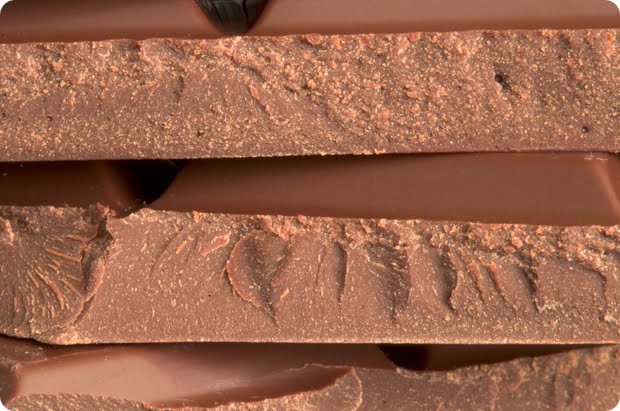
A bar of Grand Cru chocolate has a silky-matt gloss, whereas straightforward industrial chocolate looks like a plastic sample. The next two senses determine further differences: when a piec of chocolate that has been rolled backward and worward by a longitudinal conch for hours is broken of, it makes a soft snap, a tone in a minor key, almost like a soft sigh. The snap of chocolate that has been manufactured rationally and less elaborately is higher and sharper. The reason for this different music is the cocoa varity and the quality of the beans.
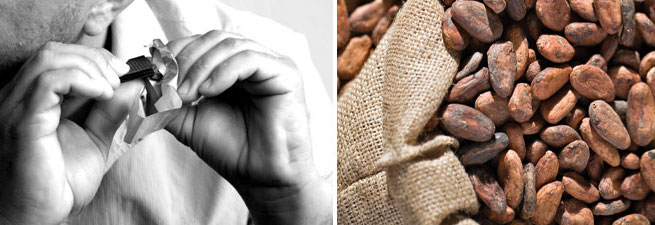
Our sense of touch tells us more. Rubing a few fragments of chocolate between our index finger and thum warms the chocolate, thus releasing the volatile aromas. Biting into the chocolate tells us about its consistency, whether it has hard or soft structure; again, the sound it makes as we bite into it is important, but the feel of it on the tongue (called mouthfeel) is also crucial.

We now allow the chocolate to melt on the tongue. One of the secrets of pleasure of chocolate is its mellow sensation: chocolate melts at 33C, which is just 3C lower than thetemperature of teh human body, the temperature that is the closest to the soul. The cocoa butter starts to melt away and the fat is broken down, the aromas unfold and develop and, because the melting point of chocolate is just a few degrees below that of body temperature (which is why chocolate initially feels cool on the tongue), chocolate can also have an intimate, comforting effect. Whilst the chocolate melts on the tongue, the taste papillae pick up all of many flavours and trigger a signal to the brain, where the taste memory is challenged. How can these flavours be graded, where classified? Chocolate we know, but what about everything else? This all has to be registered individually.
The tongue first detects the basic tastes: sweet, sour, bitter and also salty, or least mineral. By holding our breath for a momentthen breathing out gradually through the nose, we can detect the volatile aromas and basic flavours, as well as further nuances: spicy, strong and distinct (vanilla, cinnamon, cloves and other opulent, Christmassy components), refreshing and fruity (cassis, apricot and wild berries), floral (orange blossom and rose), vegetal ( brushwood and truffles), nutty (almond and macadamia), as well as roast aromas (coffee, tea or caramel) and other independent aromas (tobacco, butter, honey or beeswax). All these flavours, substances, essences and a few more nuances that can be identified with the human sensory organs and a little practice are also found in wines. Listing flavour nuances from the world of botany and other areas of life may be problematic when trying to understand complex flavor landscapes; it is often difficult to put impressions into words. However, a landscape consists of details and identifying these details, one after the other, underpins its incredible richness whether chocolate, wine or a truffle that has just been unearthed and cut open.
THE COMPOSITION OF THE COCOA BEAN
The cocoa bean contains more than 50 percent cocoa butter. Protein and starch account for a good 10 percent of the weight of the bean, with many other substances making up the balance, including the essences, which act as a stimulant and which also give us foodfor thought. On the one hand, the variety of the aromas stimulates the senses and, on the other hand, these substances also have a beneficial effect on our physical and emotional well-being. The cocoa bean contains caffeine, theobromine, serotonin and phenethylamine all substances that act as anti-depressants, anti-stress agents and that are thus relaxing. Theobromine and caffeine are alkaloids that stimulate the central nervous system and also act as diureticts.
Content of the cocoa bean: Caffeine 0.2%, sugar 1.0%, Theobromine 1.2%, minerals, salts 2.6%, water 5.0%, Polyphenoles 6.0%, Cellulose 9.0%, organic acids 9.5%, Protein 11.5%, cocoa butter 54.0%
BASIC CHOCOLATE RECIPIES
The flavour of the cocoa is determined by its origin, bean variety and processing. Chocolate is made from either single-variety or from blends of different beans. Sugar is also added. Mixing in milk powder produces milk chocolate. White chocolate does not contain any cocoa solids, only cocoa butter.
DARK CHOCOLATE: 70 % cacao and 30% sugar
MILK CHOCOLATE: 35% cacao, 40% sugar and 25% milk powder
WHITE CHOCOLATE: 35% cacao butter, 40% sugar and 25% milk powder
next time The Pleasure From Chocolate to an Agent of Delight
 This is a white chocolate cake made with ground almonds instead of flour. It has a wonderful moist gooey texture and is decorated with milk chocolate icing and dark chocolate shavings. Serves 12. Buy online at www.hotchocolates.biz
PRESS RELEASE
FOR IMMEDIATE RELEASE
On February 27, 2012, at 6:00 a.m. PST, MDP Signature Chocolates launched its Kickstarter Project ( http://www.kickstarter.com/projects/1844679095/from-firehouse-chef-to-master-chocolatier ) to raise capital to open a small chocolate factory and retail space in Seattle, Washington. The goal is to have people pledge $50,000 in 30 days. Kickstarter is the worlds largest funding platform for creative projects.
In 2004, Chef Michael D. Poole established MDP Signature Chocolates and began producing handcrafted, French chocolates under this label.These chocolates were provided exclusively to catering clients. With an increase in client demand, Michael began boxing the chocolates for retail sale on the Internet at http://mdpchocolates.com .
Since 2004, MDP Signature Chocolates has won silver and gold awards at both the Seattle and San Francisco International Chocolate Salons. The judges at the Seattle Chocolate Salon proclaimed, the lemon meringue truffle from MDP was like a bite of lemon meringue pie enrobed in white chocolate.
In addition to establishing a chocolate business, Chef Michael has served 32 years as a firefighter and lieutenant on the Seattle fire department.
FOR FURTHER INFORMATION PLEASE CONTACT:
Michele L. Simms-Burton, Ph.D.
Director of Marketing and Public Relations
571.527.7629
michelelsimms@yahoo.com
http://www.facebook.com/photo.php?fbid=331906960178308&set=a.161110650591274.27279.160235940678745&type=1&theater
I was curious what is your favorite chocolate and drink pair? I personally have been enjoying dark chocolates with a nice porter (mostly pecan porters) but I feel like trying something new. Any suggestions? I typicallypreferbeer pairings but I am open to nice wines as well.
 This cake is very quick and easy to make which I love. I am not very good at complicated recipes with too many stages, the fewer the better is my philosophy. As the cake cooks it will fill your kitchen with the most beautiful aroma of chocolate, spice and orange, the perfect natural room fragrance!
For the cake
100g butter 100g hot chocolates dark chocolate buttons 75g dark muscovado sugar 100ml golden syrup pt milk Grated zest 1 orange 175g plain flour 1 teaspoon bicarbonate of soda 2 round teasp ground ginger 1 round teasp ground cinnamon 1 large egg
For the topping
100g butter 75g hot chocolates dark chocolate buttons Juice 1 orange 50g icing sugar
Preheat the oven to 150C/300F/gas mark 3. Grease and line a 7in square baking tin with greaseproof paper. Melt the butter, chocolate, sugar, syrup, milk and zest together in a pan over a gentle heat. Sift flour, bicarb and spices into a large mixing bowl. Once melted add the chocolate mixture to the dry ingredients and beat well. Add the egg and beat again. Pour mixture into the tin. Tap the pan on the work surface to allow excess air bubbles to rise to the top. Bake in the oven for exactly 30 mins, test cake with a skewer in the centre, if it does not come out clean leave for another five mins and keeping testing until skewer is clean. Leave to cool in tin for 10 mins then empty out on to a wire tray to cool completely. Place cake on serving dish.
For the topping, melt the butter, chocolate, icing sugar and orange juice in a small pan over a gentle heat stirring all the time. Pour over the cake and eat when cold, if you can wait! Sharon
I came accross this article tonight and found the future of cocoa to be quite concerning. We all really need to be proactive in this fight for the future of Cocoa.
Take a read......what are your thoughts?
http://www.scientificamerican.com/article.cfm?id=the-future-of-chocolate
So far I can surmise or suspect that only Big Tree Farms may be producing chocolate that is truly raw. Since there are currently no industry standards in place, what is the best way to be assured that you are buying truly raw cacao nibs, butter or powder? I would like to market my confections online but I want to be sure it is truly a raw product I am offering. Raw in this sense does not refer to raw materials, but to the fact that the cacao was never heated above 40 to 45 C at any time during any part of the harvest and processing. Any other raw chocolate friends here?
This past December, one of the villages we visit every year was burned by members of the Ivorian Army, specifically pro-Ouattara forces. Broguhe was pro-Gbagbo during the last election, so this is probably a form of punishment. We (Project Hope and Fairness) are rebuilding the sewing room this week and electrifying it. In any case, Ivory Coast, which supplies 40% of the world's cocoa, is slowly rebuilding from a civil war that started in 1993 and flashes on and off.
Tom Neuhaus
I just received an offer, as I'm sure many others did, for "beta testing" of a new chocolate from a particular company. Cool. Get to sample 3 different types, provide feedback, yada, yada. Then I saw the price. For3 "shipments", eachcontainingtwo 25-gm samples (total of 150 gm, or about 5 oz.) it was about $50. That figures to be about $160 on a pound-for-pound basis. To me, that's really pushing it, especially given that the stuff is totally untested. For a "beta test" the price should be way less, since the whole point of a beta test is to get the kinks out of a developing product.
For this price, I can do far better, and for proven quality.